


Menu
By theme
By theme

{{ variable.name }} : {{ variable.values[selectedVariantsIndex[variable_index]].name }}
Quantity:
The sword mudra is one of the Daoist hand gestures: index and middle fingers held straight together, ring and little fingers curled, thumb pressed on the nail of the ring finger. The gesture is used in ritual and in martial arts, with different rules on each side. Made into a pendant, what is taken is the silhouette of the hand. There are many mudras and the sword is only one; there are also thunder and dipper gestures, each with its own finger positions. Drawings of hand gestures differ slightly from one hand to the next on how high each knuckle sits, so there is no need to check against a single diagram.
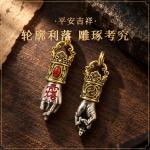
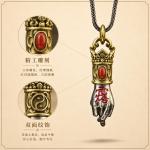
The hard part of a silhouette is the layering of the fingers. The two straight fingers have to read front and back, each knuckle of the curled fingers has to be visible, and the point where the thumb presses cannot blur. Cast in white copper, fine lines hold, but a deep narrow groove like the gap between fingers dulls the mold after a few pulls and later batches come out shallower. White copper takes a finer mold than brass, at the cost of brittleness: dropped on tile, the fingertip section goes first. Whether the nails are cut in varies by maker; cut, it looks fussy, and left out, it looks bald.
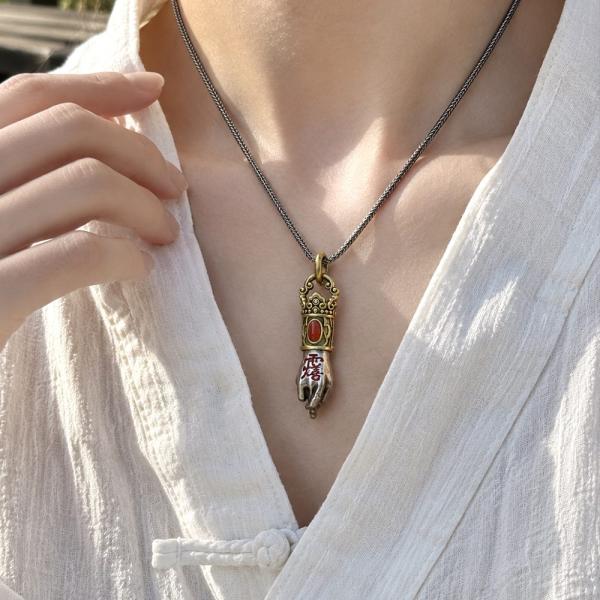
There are two versions, pendant and necklace. The pendant is the plaque alone and you find your own cord at home; the necklace comes already strung and needs nothing else. Choose a lobster clasp for the chain, since a spring clasp loosens with time. Whether the plaque hangs upright or upside down depends on whether the hole is at the wrist end or the fingertip end, and that is something you have to check against the photograph. Whether the chain length is fixed or adjustable is usually stated on the page; if it is not, ask. The two versions cost about the same, and the difference is that length of chain, so decide first whether you want one ready-made.
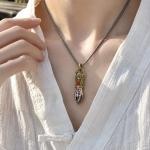
Worn on the body, whether the gesture faces out or in is a matter of opinion. Facing out it is conspicuous and other people see it; facing in against the chest, only you know it is there. A subject like this is not as legible as a wealth deity or a Tara, and someone who does not know will not see anything in it, so there is nothing to explain. With a high collar, wear it inward, where the face lies against cloth instead of rubbing skin. The finger gaps are shallow and will not hold much dirt, so once a month is enough.
White copper is not plated and the color is cold. It warms with wear, faster for people who sweat. Lift dust out of the finger gaps with a dry soft brush and do not pick at it with a needle, because every pass of a needle leaves a scratch. Bag it when it is not worn; copper against copper grinds off a black powder that is hard to clean away. White copper is close to silver in hardness and more brittle, so do not hold the fine parts in pliers.