


Menu
By theme
By theme

{{ variable.name }} : {{ variable.values[selectedVariantsIndex[variable_index]].name }}
Quantity:
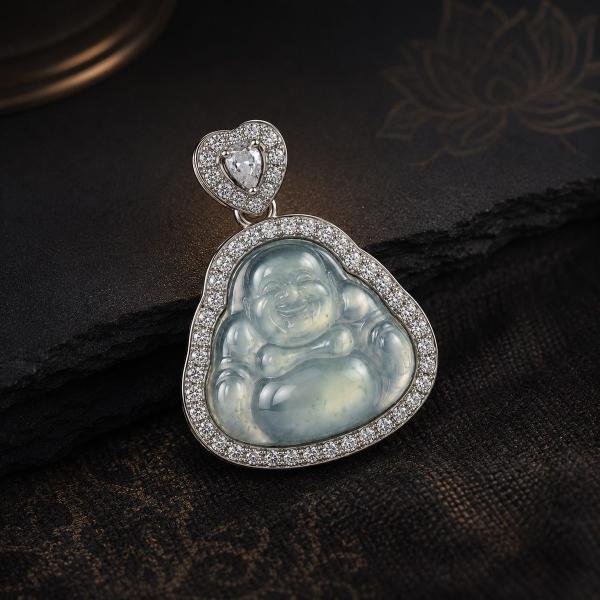
The same Buddha figure will show two different colours under a counter spotlight and by a window. Blue water means a body colour that leans blue with enough transparency; true blue water carries a little grey in the blue, like the colour of deep sea, and light passing into it has depth rather than lying flat. Much of what the market calls blue water is material with a blue ground leaning green, which the lamp exposes. The term is used far too loosely; a buyer should look at the piece in daylight. Window light at eight or nine in the morning is the most honest, and a mall spotlight the least.
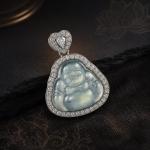
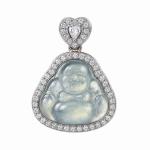
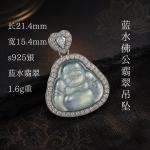
The blue here is not strong. It is the pale end of the range: grey-blue head on, a little brighter turned to the side. There is an advantage in pale material — the lines of the face cannot lean on colour and have to be carried by the carving, so the bridge of the nose, the corners of the mouth and the turn of the chin all stay legible. With heavily saturated stone the face goes dark and the features blur. This piece has a fine base; held to the light there is no obvious graininess inside. Pale blue is the most light-dependent material there is: grey on an overcast day, alive in sun. That is not a fault of this stone; it is what blue water does.
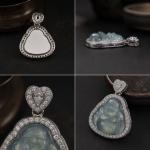
The face is where a Buddha figure lives or dies. The eyes must curve, and curve symmetrically; the two corners of the mouth must sit at the same height — one higher than the other and the smile turns bitter. The belly's curve begins at the chest, swells all the way down and closes below the navel; when that arc is carved well it feels continuous under the finger, with no ridge in the middle. Running a finger over the piece tells you more than a photograph. The earlobes hang to the shoulder, which is the old proportion; cut them short and the figure looks cramped.
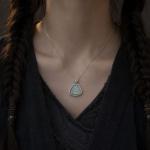
The bezel covers only the outer ring and never crosses the face, so the stone stays whole. The claws are shaped as cloud heads and tucked behind the shoulders and at the sides of the belly; from the front no metal shows. The hole sits behind the top of the head — mind the direction when you thread a chain, because the hole is angled and the pendant will right itself once hung. The inside of the bezel is polished, so it will not rub a mark into the stone. Choose a chain in silver-white or a white-gold tone; a yellow chain fights blue water, two colour temperatures stirred together.
Blue water material is usually old in the grain and dense, and it does not change with wear — that is its advantage. What it still fears is impact. Jadeite has less toughness than it appears to; dropped on tile it will break like anything else. Take it off for heavy work or sport and put it in a fixed box rather than dropping it into a pocket. When sweat is heavy, rinse it in clean water and blot it with a soft cloth — not a paper towel, which contains wood pulp and leaves fine scratches.