


Menu
By theme
By theme


{{ variable.name }} : {{ variable.values[selectedVariantsIndex[variable_index]].name }}
Quantity:
The crane was the bird on a first-rank civil official's badge in the Qing dynasty. A badge was a square of fabric sewn to the front and back of a court robe, birds for civil officials and beasts for military ones, a crane at the first rank, a golden pheasant at the second, and so on down the list. So the crane in traditional ornament is not simply a bird. It carries rank. That is one line of meaning. The folk habit of reading the crane as a sign of long life is another.
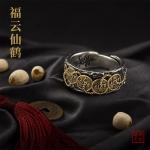
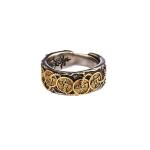
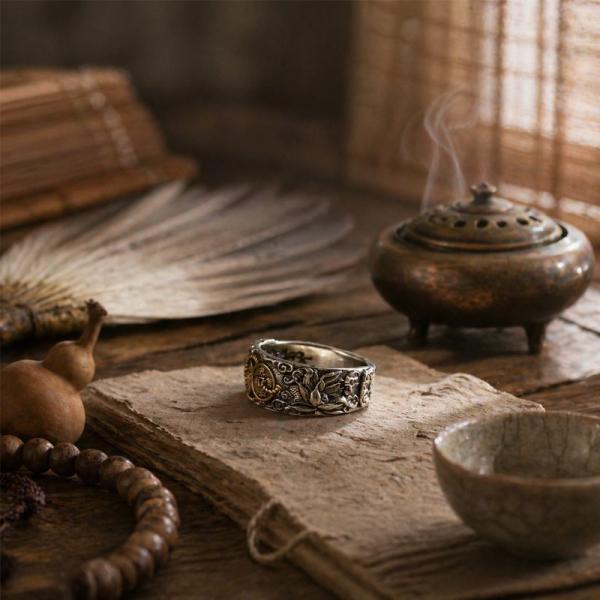
The crane on the ring stands with one leg drawn up and one foot down, the neck bent into an S, a spot of red on the crown, the wings half open. The pose can be traced back to the Song painting Auspicious Cranes, where the birds wheel above a palace in a dozen different attitudes, and most later crane painting takes its movement from there. The difficulty is the neck. A long thin line has to bend naturally and not look like a rope with a knot tied in it. The red crown is a dot of cinnabar in a painting; in metal it becomes a small raised bump, and the top of that bump has to be flat. Pointed, it feels like a thorn under the thumb.
The coin part follows the tradition of charm coins. A charm coin was never currency. It was a pendant cast in the shape of a coin, already around in the Han dynasty, inscribed on the face and patterned on the back, worn on the body or sewn onto a curtain. So imperial coin here most likely means a coin shape carrying an emperor's reign title, and it should not be mistaken for real money. Nobody makes a ring out of real coinage, because once the inscription is ground away the object is worthless.
The auspicious cloud is one type of cloud motif, the head curled into a ruyi shape with a thin tail trailing behind it. Cloud motifs are the easiest thing in the world to overdo on a ring, layer on layer until the whole thing becomes a ball of cotton wool. This one uses three clouds only, one above the crane and two at the sides, and leaves more blank than cloud so the bird has room to fly. Position matters as well. A cloud head must not sit over the crane's head or wings, because that smothers the picture.
With an open ring, err on the small side to begin with. White copper will open a little, but once it has been opened too far it will not close again and it turns on the finger. Take it off to wash your hands. Soap works into the gap and leaves a white line there in time. The cinnabar tone on the crane's crown is mostly produced by a small concave facet catching the light rather than by any colour, so do not rub that one spot hard with a cloth.