


Menu
By theme
By theme


{{ variable.name }} : {{ variable.values[selectedVariantsIndex[variable_index]].name }}
Quantity:
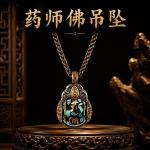
In images of the Medicine Buddha the two objects in his hands are the easiest way to recognise him. The left hand holds a medicine bowl filled with medicine; the right holds a myrobalan plant, common in the Tibetan system, its leaves and branches shaped like a small pagoda. Chinese images are less fixed about implements, so recognition rests on the bowl and the lotus seat. A small pendant has limited space, and keeping the bowl counts as having explained the figure. The myrobalan fruit looks like a small olive with several longitudinal ridges, easier to identify than a face. Chinese Medicine Buddha figures often hold a bowl as well, some round and some with a lid.
Bhaisajyaguru, the Medicine Buddha of Lapis Lazuli Light, is the teacher of the Eastern Pure Land of Lapis Lazuli, attended by the bodhisattvas Suryaprabha and Candraprabha, who together with him are known as the Three Medicine Buddhas. The sutras say that while walking the bodhisattva path he made twelve great vows, each of them concerned with the sickness and deprivation of beings. That is canonical content, the background to the image, not a promise that wearing it will do anything. The text of the vows is long and need not be memorised; knowing where they point is enough.
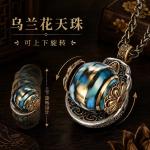
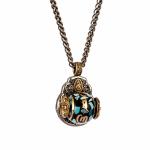
White copper's cool white suits this subject and does not compete with the gravity of the figure. The recesses are darkened so that the channels of the drapery go black while the face and hands stay bright, which gives light and shade at a distance. What needs care is the face: the Medicine Buddha is usually peaceful, with lowered brows and eyes, and carved too deep he looks sorrowful while carved too shallow he looks wooden. That balance is harder than drapery. Small white copper figures suffer most from too many moulds, and by the third generation the face has blurred.
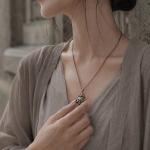
The size of the pendant and the length of the chain should be decided together. A small pendant on a long chain looks stranded; a thick pendant on a fine chain tips forward. Giving it to an older relative is the most common use, with the length set above the chest so it is easy to put on and does not press. Before giving it, ask whether they wear necklaces at all, which is safer than guessing. The pendant has thickness, so leave some room in the clothing, or the outline shows sharply.
White copper dislikes both sweat and perfume. Worn against the chest in summer it will need a wipe with a soft cloth when you get home. Sweat grime collecting in the recesses turns green; work it out with a soft brush and clean water, then dry it at once. Do not use an ultrasonic cleaner, since water in the seams does not come out properly and the piece darkens as a result. Wipe along the drapery lines, because wiping across them drags the dark out of the recesses.