


Menu
By theme
By theme






{{ variable.name }} : {{ variable.values[selectedVariantsIndex[variable_index]].name }}
Quantity:
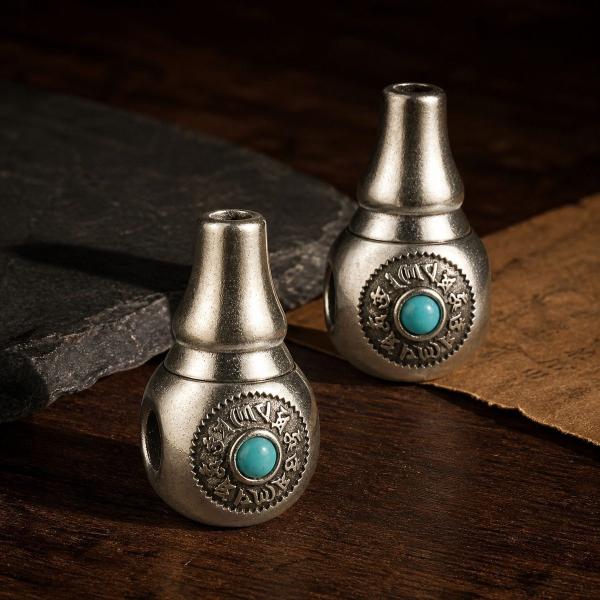
Engraving a three-hole bead is harder to lay out than to cut. The bead is round, the three holes divide the surface into panels, and the letters have to travel round without crossing the hole mouths. The six-syllable mantra has exactly six syllables, so it goes round once: start at the front, hide the finish at the back, and from the front you read a complete line. The spacing has to be even, because tight crowds it and loose scatters it. Working through six characters, the last one is usually squeezed, or it breaks at the edge of the hole.
The six-syllable mantra is Avalokiteshvara's heart mantra, om mani padme hum, the six characters most often seen in Tibetan areas. They are carved on mani stones, placed inside prayer wheels and repeated by old people as they walk. Each syllable has a corresponding meaning, and there is more than one way of explaining them one by one; what the readings share is that they come down to compassion and awakening. Om opens and hum closes, and the four in between are each understood in their own way. Cut into brass, the turns should be round, since square corners look stiff.
Brass is softer than white copper, which actually helps when cutting letters. The strokes can be cut deep, with variation in thickness, and the edges carry a slight curl of brass that takes the colour first when the piece is aged. White copper is harder, so the lettering is crisper but shallower and wears flat sooner. The two materials go different ways and neither is simply better. With brass, once the lettering is darkened the black and the dark ground can merge, and a shallow cut disappears, so engraved pieces are better cut on the deep side.
A three-hole bead takes the cord three times, and how smooth the holes are decides how long the cord lasts. Cast pieces often have burrs at the mouth, so run a fine abrasive strip round them first, then pull a scrap of cord through a few times to feel for roughness. A little wax inside the hole lets the cord run smoothly and saves years of wear. If the lettering faces straight forward once the bead is fitted, the holes were drilled accurately. Turn it afterwards and feel for any point that catches.
When assembling, the lettering has to face outward, which is the minimum requirement. Some people fit the bead the wrong way round, so the text sits against the wrist and only they know what it says. Do not let the main beads be too colourful: brass is heavy in itself, and dark wood or bodhi root sit well with it, while bright glass beads make it noisy. The three-hole bead is the hinge of the strand, so do not choose a colour that jumps. If you are stringing for the first time, run it with cheap cord before committing.