


Menu
By theme
By theme



{{ variable.name }} : {{ variable.values[selectedVariantsIndex[variable_index]].name }}
Quantity:
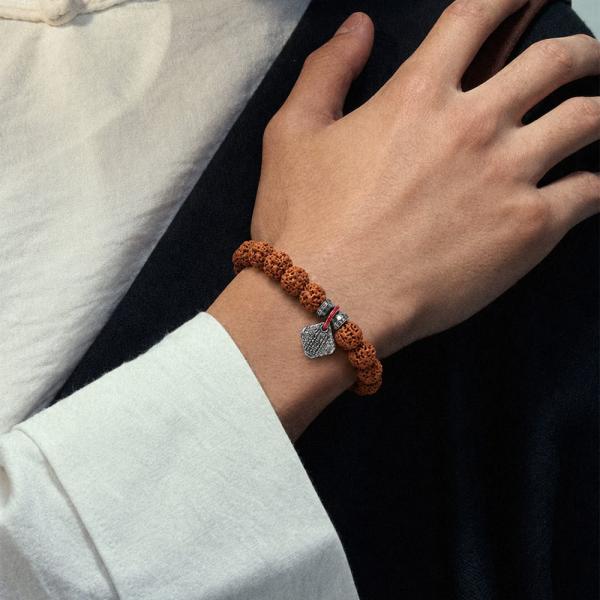
A long mala of one hundred and eight beads usually has spacers set at the twenty-seventh, fifty-fourth and eighty-first positions. Reach a spacer and you know you are a quarter of the way round without looking down to count. That is the real job of the bead, and it has nothing to do with how it looks. It is also why spacers are mostly sold in sets; a single one is no use on its own. Short strings do not need them at all. On a twenty-one bead wrist mala, one top bead and one three-hole bead are enough. Add spacers and it gets crowded.
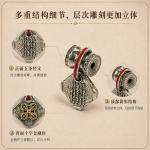
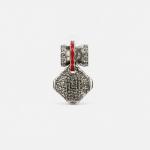
This one is a cylinder. Five lines of Tibetan run across the face in rows, cut shallow, so you have to tilt it to the light to read them. Five lines of scripture crowded onto one bead means the letters must be small. Cut too deep and they merge into a smear; cut too shallow and two wearings flatten them. The maker has to find the line between. Tibetan strokes have heads and tails, level horizontals and upright verticals, and cut on a curved face they distort a little. That is a trace of the hand, not a flaw.
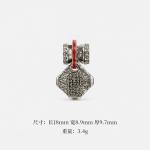
White copper is cast first and the lettering cut afterward, which leaves a fine ridge at the edge that feels slightly sharp. Two passes with fine sandpaper along it before stringing takes care of that. The hole is centered and not large: heavy cotton cord will not go through, while waxed cord or a finer elastic will. White copper sits in the middle for hardness, so the chisel does not chip it, and that is exactly why small pieces like this use it. Brass is softer, and lettering cut in brass tends to collapse.
I do not translate the five lines one by one. Tibetan punctuation and Chinese renderings do not line up, and forcing a translation invites mistakes. Most buyers do not ask what it says either; they treat it as a mark. Plainly, then: if you do not know, do not explain it on someone else's behalf. A wrong explanation is ruder than none. One customer did take his to a monk and came back to tell me which passage it was. I cannot remember which. I remember that he was pleased.
One bead for a wrist mala, three for a long string. In color it is darker than silver and cooler than brass, and it holds its own with south red agate or amber on either side. Some people use it as the top bead, which is the wrong position: the top bead has to be a three-hole bead, and a spacer is only the one that passes through. Better to explain that once than to have it sent back and forth. Bought as a set the price is lower; a single bead costs more, because casting runs in batches. If you need three at once, say so in advance.