


Menu
By theme
By theme


{{ variable.name }} : {{ variable.values[selectedVariantsIndex[variable_index]].name }}
Quantity:
The old name for the beast-face motif is taotie, from a line in the Lüshi Chunqiu: on the Zhou cauldrons taotie were cast, with a head and no body; they ate a man and could not swallow him, and the harm came to themselves. The sentence covers the look of the motif and its meaning at once. Only a head survives, because there is no body. Those four characters, “head but no body,” later became a watchword for reading bronzes: see a head with no body and you know the type.
On Shang and Zhou bronzes the beast face is strictly symmetrical, hinged on the bridge of the nose, the eyes bulging, the horns in several families — ox, ram, feather-shaped — with a body and tail curling away on each side. To read one, first check whether the two eyes are the same size, then whether the root of the horns is cleaned up sharply. Those two places show the hand most easily. Shang faces are blunt and broad, Western Zhou ones pulled tighter, Warring States ones scattered into geometric lines. See enough of that sequence and you can place a piece by period.
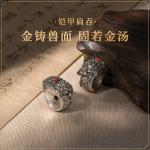
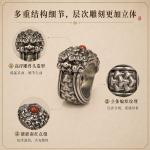
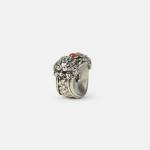
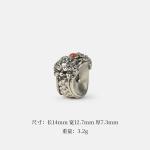
This one is small, under a coin in diameter, and the relief is pressed shallow. The advantage is that it does not dig into the wrist; the drawback is that in low light the pattern disappears. The recesses are darkened and the high faces left bright, and on a small piece that contrast matters more than on a large one. Blur it and all you have is a lump of copper color. A small piece does not need presence; it needs to keep the eye. Turned between the fingers the pattern should not prickle, and too crowded reads vulgar. The fine down-like grain should still be visible. That comes from the sand mold.
A spacer sits between beads, and both of its faces are seen, so this one is worked on both sides, identical front and back. The hole runs through the middle. When stringing, keep the fang side from facing down: those two points are the first to break if the piece knocks against a table edge. A two-sided casting costs twice a single-sided one. The sand mold needs an extra core, that core is the piece most likely to shift, and if it shifts the two faces no longer line up.
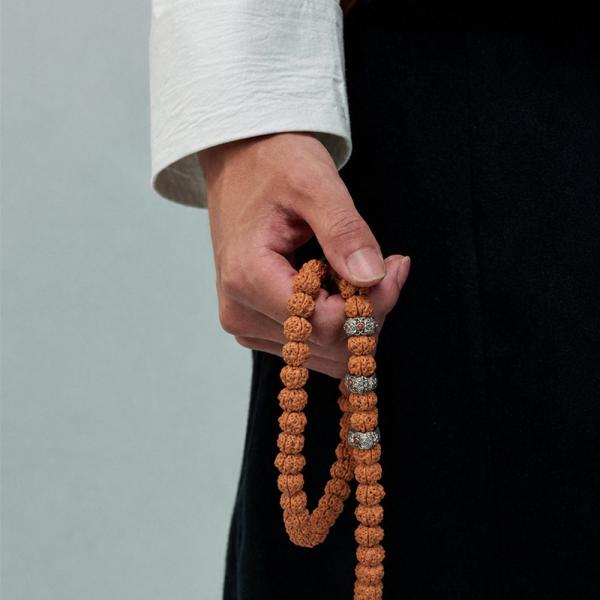
It suits dark wooden beads and coconut shell best. The wood tone presses the beast's ferocity down so it does not jump out; against white beads it looks hard. Some people find the face frightening, which is treating taotie as a demon. On a bronze it was originally a layer of order holding the vessel. When choosing companions, one side dark and one light works best, so the face has somewhere to land. All one color and it sinks. A string needs a main note and a supporting note before the whole thing holds together.