


Menu
By theme
By theme


{{ variable.name }} : {{ variable.values[selectedVariantsIndex[variable_index]].name }}
Quantity:
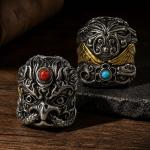
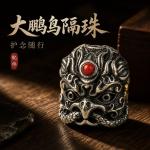
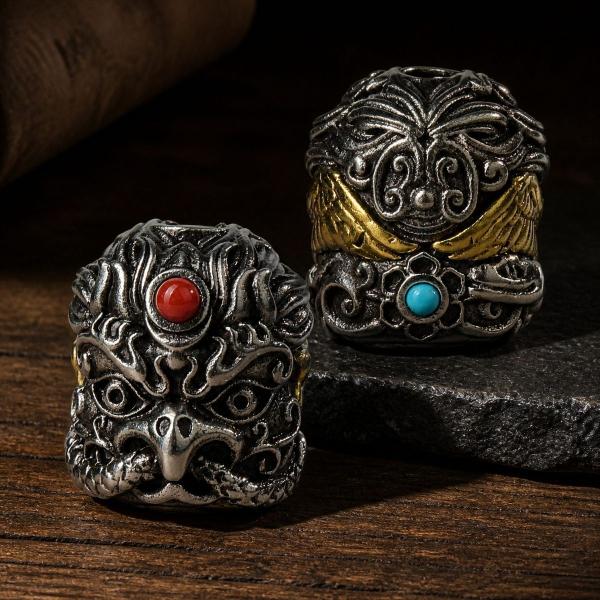
The Garuda is the king of birds in Indian myth, counted in Buddhism among the eight classes of dharma protectors, and known in Tibetan as khyung. Once the image reached Tibet it settled into a fixed form: a bird's head, two horns, wings spread wide, a snake gripped in the beak or under the claws. In Buddhist usage the snake stands for the naga spirits, and that action is the core of the story the figure tells. The image passed through Nepali and Tibetan workshops for centuries; in China it is often simply called the great peng bird.
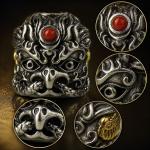
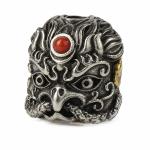
In Tibet it appears on lintels, column capitals and cabinet doors, usually above an entrance and doing much the same job as a door god. Made into a spacer bead it shrinks to the size of a fingernail, and the wings can only be summarised in a few lines. The horns have to survive, or it becomes an ordinary bird. The angle of the wings sets the width of the whole piece: opened too far it takes up space, closed too tight it loses presence.
This one is copper, dark in tone, with deeper hollows and a thin sheen left on the raised passages. The mould's parting line sits on the side of the piece, where it is not obvious unless you look for it. The feathers are laid out as short parallel strokes, and whether the spacing is even is the most direct test of the work. The colour is dark, the hollows darker still, and the high points brighten where fingers have handled them.
A spacer like this has two uses: between the main bead and the Buddha head, as a transition, or at fixed counts along a long strand, where it serves as a marker for counting. The first is more common and looks better, since the figure already carries a sense of conclusion. The bore has to match the cord — too loose and it slides up and down, too tight and it abrades the cord as it goes through. Run a finger along the edge of the wings; a thin flash of metal means the fettling was not finished and it will scratch the skin in time.
Copper does not mind water at all; what it minds is prolonged damp. Dry it after washing your hands, and do not keep it in the bathroom. Do not attack the dark in the hollows with toothpaste: the abrasive takes the shine off the high points as well and leaves the whole piece a matte sheet of copper that takes a long while to bring back. A drawer is a better home for it than a hook by the basin.