


Menu
By theme
By theme


{{ variable.name }} : {{ variable.values[selectedVariantsIndex[variable_index]].name }}
Quantity:
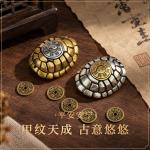
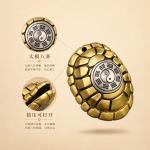
On the number of plates on a turtle's back, the old saying runs thirteen: three in the middle in a line, five on each side, plus twelve on the belly, and together they make a set of numbers. That set was attached to the Luoshu, and the derivation is said to be very old. Whether it is coincidence I would not dare say; at least it is easy to count while you handle the piece. The three plates at the center of the back feel raised. That is the shell's own structure, not carving.
The Luoshu comes out of the legend that “the Luo gave forth the writing”: a divine turtle surfaced from the Luo river with a pattern on its back, and Yu the Great took it as a model and made the nine categories. The turtle thus became the bearer of diagrams and texts, and carving the bagua on a shell follows that road. The Han dynasty diviner's board and the later compass both show the lineage. A diviner's board has two layers, a sky plate that turns and an earth plate that stays, with the bagua and the stems cut into them. The sky plate is round and the earth plate square, which matches the round back and square belly of a turtle. Objects carved with the bagua usually keep a plain border so the characters don't wear.
The bagua has two arrangements, Earlier Heaven and Later Heaven, and the wrong one will be picked out by anyone who knows. Earlier Heaven puts qian south and kun north, li east and kan west; Later Heaven puts li south and kan north, zhen east and dui west. This piece uses the Later Heaven arrangement, consistent with a compass: hold it with li at the top and south is up. Neither arrangement is wrong; they serve different purposes. Earlier Heaven for generation, Later Heaven for direction. On objects, Later Heaven is the usual choice.
Brass is aged with sulphur: the recesses go black, the high faces are polished bright, and the bands of light and dark lift the lines of the hexagrams. An aged piece fears sweat. A sweaty hand for a fortnight and the black fades, the bright goes dull. Then wipe it with a dry cloth; do not wash it. Brass has a strong metallic smell, and when new it leaves a tang on the hand that fades with handling.
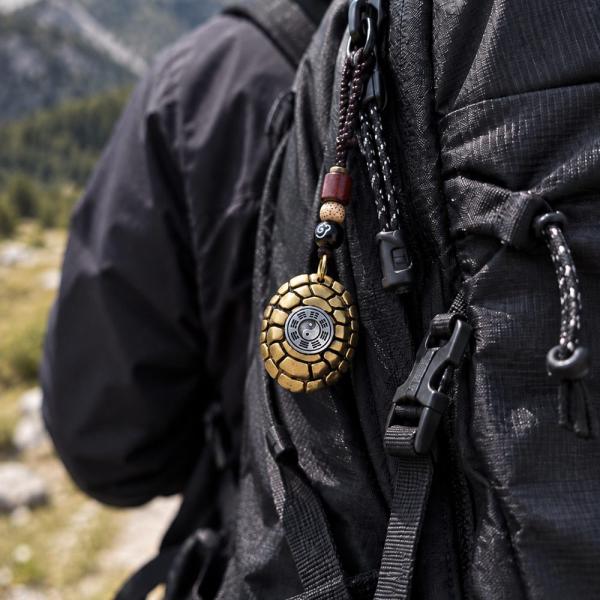
A hand piece wants clean hands. Rub it when there is no oil or sweat on them and the patina comes up thin and even. The cord version is a spare: threaded through the hole at the turtle's head and hung at the belt or on a bag, most people never use it. Two colors, gold and silver. Gold is the natural brass; silver is plated and will show base metal after long wear. The size has to fit the hand: too large and you can't hold it, too small and it has no weight. This one is made to the palm, with the thumb landing on the central plate. Copper does not mind water; what it minds is the salt in sweat.