


Menu
By theme
By theme

{{ variable.name }} : {{ variable.values[selectedVariantsIndex[variable_index]].name }}
Quantity:
In the northern suburbs of Lhasa there is a Zakhi temple whose main image is hers. The temple is small and the incense is heavy. Most people who go are asking for money, and the stalls at the gate sell a lot of liquor, because she has a taste for it. This is local Lhasa knowledge, and outside Tibet few have heard of it. The liquor offered in the temple is barley wine, bottle after bottle lined up on the altar, half of it left behind when you go. That is local custom, not a gimmick.
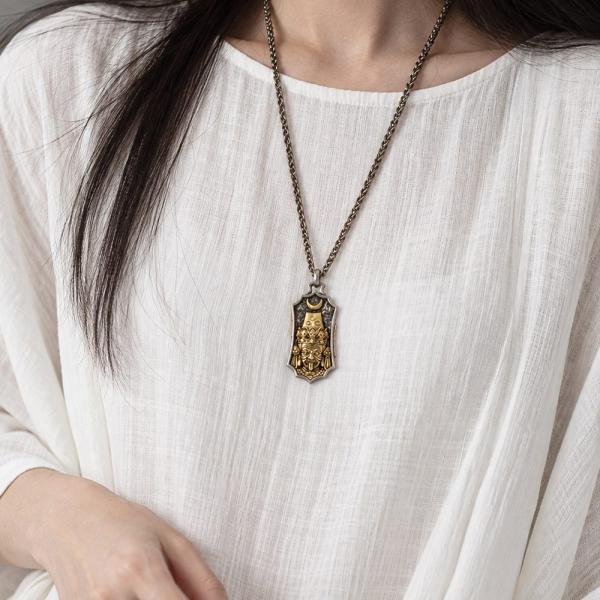
Her face is dark, the eyes glare, the tongue is out, and she wears a crown. Such a face is not unusual among protectors; what is unusual is that she is worshipped as a wealth deity, and by people of every background. Ferocity and prosperity in one place feel wrong at first; after a while they seem reasonable. Her origin has several versions in legend — a woman who came from elsewhere, a local spirit — and the accounts don't agree, nor do they need to. There is also a trace of sorrow between the brows that other deity images don't have. The carving on the plaque is shallow: tilt it to the light and the pattern appears, straight on it is a blank face.
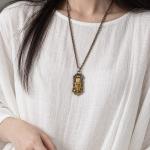
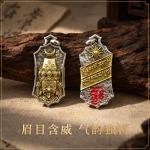
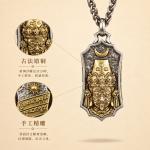
The plaque is rectangular with rounded corners, relief on one side and plain on the other. It is made thin so it doesn't bulge against the chest, at the cost of low relief: from the side there is only a shallow layer. That trade-off can't be avoided on a small plaque. Raise the relief and it has to be thicker, and thicker means heavier. A thin piece has one practical problem — it warps. To check whether it is flat, lay it on glass and press each corner; any lift will show.
Worn against the skin, white copper collects a haze on the back in a sweaty summer; wipe it clean and leave it overnight and the haze goes. Don't use a synthetic cord; it chafes the skin. Cotton or waxed cord both work. The hole is at the top with a chamfer at the edge, so long wear won't cut the cord. Over time it takes on a soft sheen, the work of sweat and cloth together, and it can't be hurried or wiped on. Change the cord once a year and the hole edge won't wear thin. If you sweat a lot, wipe the piece after wearing, and don't let salt water sit in the recesses of the relief.
For someone in business, say it plainly first: she is a local protector of Lhasa, not a wealth deity in the general sense, and elsewhere she may not be recognized. Said that way it loses nothing and makes you sound like you know the field. If it is really about the auspicious meaning, a Yellow Jambhala is better known. Some people use her as a protective charm and carry her on long trips. I neither urge nor forbid that use; everyone has their own way of settling the mind.