


Menu
By theme
By theme


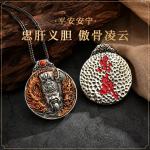
{{ variable.name }} : {{ variable.values[selectedVariantsIndex[variable_index]].name }}
Quantity:
In the official histories Guan Yu is a general of Shu Han. Being made a king and then an emperor came later, from the Song dynasty on, with Ming and Qing titles piled on top until the name “Emperor Guan” appeared. From man to god is seven or eight hundred years, and that distance is itself the story. Song titles climbed to “Prince of Righteousness, Valor and Martial Peace,” the Wanli reign of Ming raised him to emperor, and Qing titles ran past twenty characters. The line is clear.
Images divide in two: one holds the Green Dragon crescent blade, the other reads the Spring and Autumn Annals at night. The first is the martial form, the second the civil. Which one a place honors varies; in some towns merchants keep the one with the blade, in others the one reading. I don't decide for people. I ask first which form the family already had. The book in the civil form is open at the pages on honoring the king and driving back the outer tribes, and that detail matters in old paintings. In the old images I have seen, the civil form is more common, and the martial form mostly kept by shops. The blade is carried across the shoulder, not stood on its butt, and old portraits make that clearest.
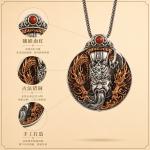
The difficulty in white copper Guan Yu is the brows, the eyes and the long beard. The reclining-silkworm brows have to sit heavy, the phoenix eyes narrow and long, and the beard divided into strands rather than smeared into one mass. Look first at the line from nose bridge to chin when the casting comes out. If that line is true, the face stands; off a little and the whole face floats. Five strands or three varies by region. Fine division reads scholarly, coarse reads commanding. The casting is thick, and the finishing has to come off layer by layer; hurry it and you cut into the face. Half a millimeter in the height of the brows and the expression is a different one. That is where finishing separates good from bad.
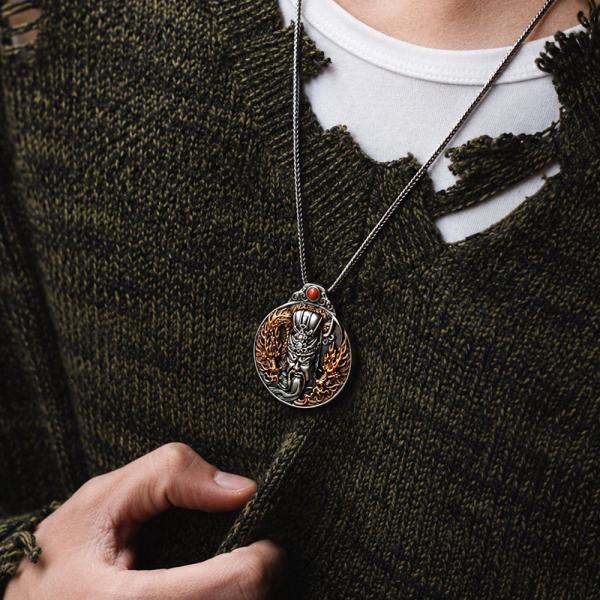
The pendant is the plaque alone; the necklace comes with a chain. Guan Yu's plaque is narrow and long, so the cord should sit close to the neck and let it fall just below the collarbone. Lower and it turns over. Use a square-link chain; a round-bead chain is too soft to carry the weight. The back is plain, and you can take it to have a name cut. A deep red or a black cord suits the plaque. Red jumps too much and fights the face; black holds down that grave air.
As a gift, loyalty and righteousness is a steadier line than drawing wealth. A businessperson who receives it takes the point about putting right dealing first and making the business last; for a younger person it is about keeping your word. Some people ask straight out whether it works, and there is no answer to that. I only say the form is old, the work is new, and if you like it, wear it. Some buy it to set up in the shop, and then it is not an ornament anymore; it needs a stand. I don't carry stands; those have to be found elsewhere.