


Menu
By theme
By theme


{{ variable.name }} : {{ variable.values[selectedVariantsIndex[variable_index]].name }}
Quantity:
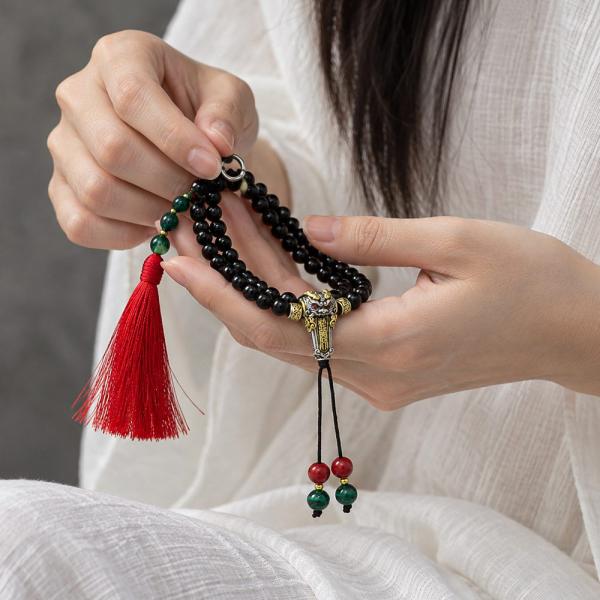
The three-hole bead is the bead on a mala that has three holes, also called the buddha head. One horizontal hole runs through both sides; once strung, the whole string gathers here and the pendant hangs below. It sits at the top, so the work on it shows most, in plain sight. The other two holes run vertically, one above and one below, and the “three” in the name comes from those three holes.
The back-cloud is a component of the court necklace, hanging below the buddha head and down the back. Qing court necklaces had a fixed form: a hundred and eight beads for the body, with the buddha head, back-cloud and counters each in its own place, not to be shuffled. The back-cloud sits behind, holding down the collar and balancing the weight front and back. Court necklaces were the ornament of Qing officials, and rank decided the material of the beads. Nobody sees it, and the fastidious still did it properly. Back-clouds come square or in the shape of a lock plate, and the material followed rank.
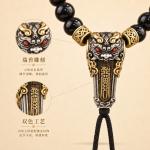
The pixiu is a legendary auspicious beast. Folk saying has it with a mouth and no anus, so it takes in and never lets out, which is why it is placed in the wealth position. The saying is widespread; belief is each person's business. On a fitting it is usually crouched, head facing out, a coin in its mouth. Pixiu come male and female, and the old rule has the male's left foot forward and the female's right. On a small piece that distinction is usually dropped. The mouth has to be cut deep — shallow and it cannot hold the coin — and that is one place to judge the work.
The two uses of this piece have to be kept apart. As a back-cloud the hole runs vertically, and the cord passes from top to bottom. As a three-hole bead it needs three holes, one horizontal and two vertical. Ask before buying which one it is; mix them up and it comes back for exchange, and the round trip costs time. The usual result of stringing it the wrong way is a pendant hanging off to one side, awkward to look at and swinging against the leg as you walk. Get one end wrong and the whole string has to be taken apart back to the buddha head and redone, which costs time and cord.
For stringing, copper goes best with wooden beads and bodhi root, and fights with bright polished stone. Copper oxidizes, its color moving from bright yellow to dark brown. Some people like the process; others find it dirty. If you find it dirty, wipe it often with a soft cloth, not toothpaste — toothpaste contains abrasives. Bodhi root is white when new and turns yellow after half a year of handling, which runs right alongside the darkening copper. Don't keep copper in the same box as silver; the two metals dull each other over time.