


Menu
By theme
By theme




{{ variable.name }} : {{ variable.values[selectedVariantsIndex[variable_index]].name }}
Quantity:
The nine-syllable mantra comes from Ge Hong's Baopuzi, in the chapter on entering the mountains, and the original reads lin, bing, dou, zhe, jie, zhen, lie, qian, xing. The book says it is recited on going into the mountains, and that with it recited the things in the mountains dare not come near. Nine syllables, one beat each, and it sounds like a command. The Baopuzi passage goes on to give the method: hold the breath, pace the steps. It is not just saying the words. I won't go into that here. The first four, lin bing dou zhe, are the easiest to remember, and people often get the rest wrong.
Carried to Japan it became the nine-character cut, with variant characters, the last line usually written a little differently. The readings differ on both sides; the source is one. People who have seen the difference like to test me on it, and I can't say who is right, only that each has its own transmission. In esoteric Buddhism the nine syllables pair with nine hand gestures, one syllable to a gesture, with fixed rules for how the fingers lock. Nine syllables take about a dozen breaths; fast or slow is up to the person, and there is no need to follow someone else's pace.
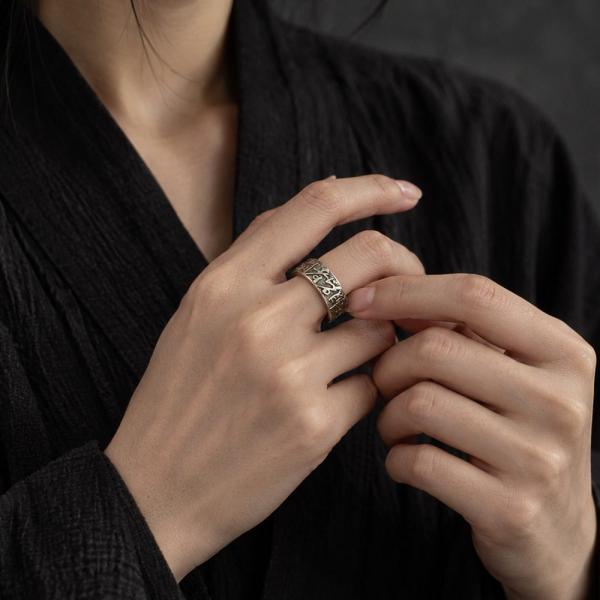
Whether to set the nine characters in one ring or in two rows on the ring is a trade-off. One ring needs even spacing, with the join on the inside where it cannot be seen once turned. Two rows allow larger, clearer characters, but the gap between them can look like a break. This one is in two rows, cut deep. The pause comes after zhe, and the spacing follows the phrasing, which is what reads smoothly. The characters have different stroke counts, so the spacing has to be adjusted rather than laid out mechanically.
The aging turns the characters in the recesses black while the high faces keep a matte finish, and the characters float up. With long wear the black recedes until characters and ground are one tone. A soft cloth won't bring it back then, and the piece needs re-aging. That is consumption, and it is worth knowing when you buy. The black of the aging is bitten in with a chemical, not painted on, so it cannot be wiped off; it only wears lighter.
The opening adjusts, and it will roughly fit anything from a slender to a thick finger, at the cost of going slack with long bending. Wear it on the index or middle finger, not the ring finger; the direction of force on the ring finger is wrong and it deforms easily. As a gift this one doesn't divide by sex, and it is steadier than a carved pattern. The band is on the thick side: in summer it feels close, in winter it is just right. If your fingers swell easily, take one size up. A finger size measured in autumn or winter is more accurate than one taken in summer.