


Menu
By theme
By theme

{{ variable.name }} : {{ variable.values[selectedVariantsIndex[variable_index]].name }}
Quantity:
The thunder pattern is one of the earliest geometric patterns on bronzes: a squared spiral linked to the next, running round in a band. It appears on Shang cauldrons and stays in use into the Han. It is simpler than the taotie and harder to lay out, because it has to be even. One line has to be drawn in a single breath; break the flow midway and a connoisseur sees at once that it was traced. The corners must be square; round them and it becomes a cloud pattern.
The name cloud-thunder comes from the way it looks both like a curling cloud head and like the roll of thunder. In the same family, the rounded turns are called cloud and the squared ones thunder, though in practice they are mixed and not so easily separated. Archaeological reports often write the two words as one term. Round and square crowded onto one vessel: at first it looks full, and only after a while do the layers separate.
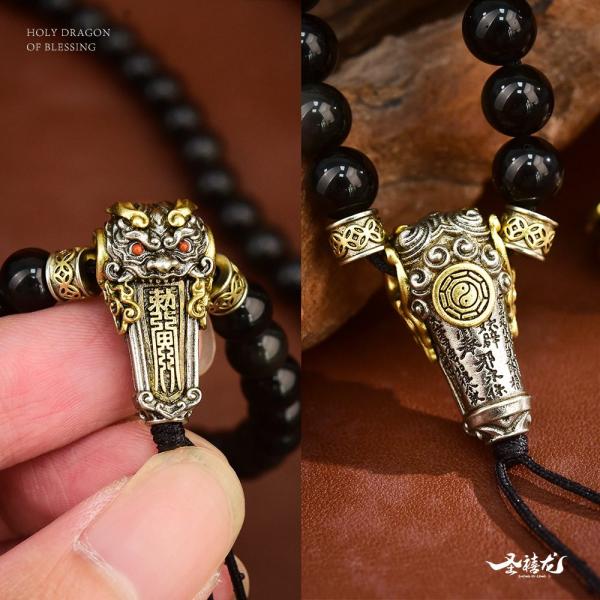
The spell on the mountain ghost charm coin opens with “thunder, thunder,” and only then come the lines about killing ghosts and subduing spirits. Thunder and the mountain ghost were linked from the start, so pairing a thunder pattern with a mountain ghost fitting is not a random match; it follows the original text. The charm coin carries more than one spell, and there are versions with the bagua on one face and the zodiac animals on the other. Mountain ghost with thunder pattern is one of those lines. The bagua on the back may follow the Earlier or the Later Heaven order; look carefully when you buy.
A three-hole bead sits at the top of the string: the main cord runs through horizontally and two vertical holes take the pendant below. On this piece the thunder pattern is cut on the front and both sides, with the back left plain; the face against the beads doesn't need the work. The hole mouths are chamfered so long wear won't raise burrs. A three-hole bead carries load, so the walls cannot be thin. The walls here are thick enough that heavy cord won't split the hole. Drill it true and the line runs straight; a little off and the whole string twists.
For stringing, this one runs hard, and suits dark wooden beads or black stone; against pale beads it looks abrupt. Copper oxidizes and needs no particular care; handling it often improves it. Kept in a drawer unworn, it goes dull in a couple of years, and a wipe brings it back. Black stone, coconut shell and dark wood are all steady companions. Turquoise makes it jump, unless there is another note somewhere on the string to answer it. Even black looks good; patchy black and white is what looks dirty.