


Menu
By theme
By theme


{{ variable.name }} : {{ variable.values[selectedVariantsIndex[variable_index]].name }}
Quantity:
The words Mahakala point at different figures depending on where you stand. In Tibetan Buddhism he is a protector, wrathful, and the six-armed form is the one you meet most often; in Japan the same root turned into Daikokuten, a god of wealth with a sack over one shoulder and a mallet in his hand, grinning until his eyes disappear. One origin, two very different faces. Know which one you are buying before you order, and do not read the Japanese fortune god into a Tibetan image. In temple murals he is usually painted to one side of a doorway or around a corner, where nobody looks first.
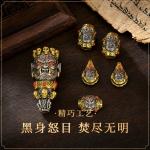
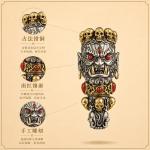
This set belongs with the DIY fittings, loose pieces put up for people who string their own beads, and buying the set is less work than hunting down each part on its own. A set here means pieces for several positions on a strand matched together. How many pieces and which positions they take is not spelled out on the page, so the safe move is to ask before you order. The copper is left uncolored, a red-copper base, with the antiquing pressed into the hollows and the raised faces kept bright; that difference in depth is what makes the pattern stand up.
A wrathful face reduced to fitting size is where casting gets hard. The flame hair flares out strand by strand, thin enough to blur into one lump; three eyes crowd onto a face the size of a fingernail, and once the boundary between white and iris softens the whole face goes blunt. The skull crown has five petals and the gaps between them have to survive; wax left in a gap comes back as solid metal. Turn the piece slowly against the light and check whether those points are still there. Copper is a soft metal and molds wear, so sharpness drifts a little from one batch to the next.
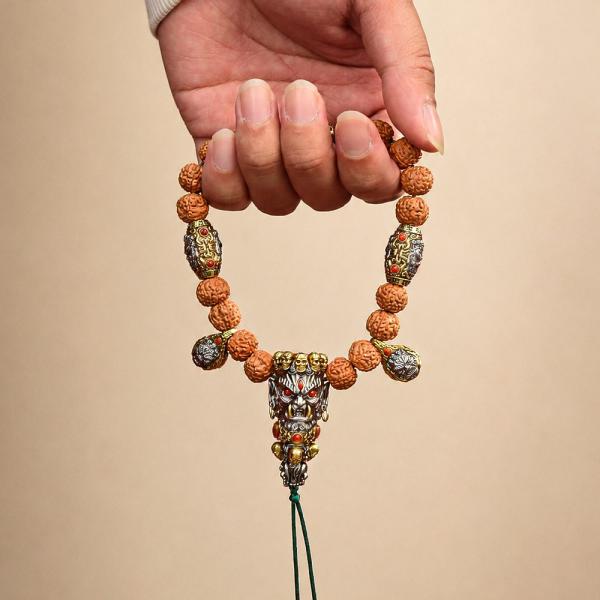
On a strand the copper runs dark red and holds down dark material. Coconut shell, rosewood, dark bodhi seed: the copper sits between them without fighting for attention. Against South Red agate or turquoise the colors collide and separate into layers instead. The piece at the three-hole position shows more than a spacer does, so one is enough; add more and the strand sags. On a thin wrist do not go large. Once the weight sits off center, the strand keeps swinging around to one side.
Copper goes dull with time, and the antiquing in the hollows blackens first. That is ordinary oxidation; it does not wipe off and does not need to. Clean with a dry soft toothbrush and keep water away, because water collects in the gaps between petals and strands of hair and dries as a white ring. Match hole size to cord size before you string: the holes are small, a thick cord will not pass, and forcing it chips a piece out of the rim. Store it in its own bag; thrown in with keys it is scratched within two days. Ask for the weight of a single piece. A set has many pieces, and the total weight tells you nothing about how thick any one of them is.