


Menu
By theme
By theme



{{ variable.name }} : {{ variable.values[selectedVariantsIndex[variable_index]].name }}
Quantity:
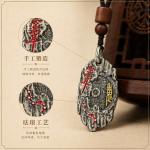
A charm coin is not money. People used to cast these copper discs with auspicious phrases and talismanic writing on them, hung from curtain hooks or laid at the bottom of a chest; the formal name is yansheng qian, a coin for subduing, and they turn up more and more often after the Song. The Shan Gui coin is one branch of that family, script on one face and usually bagua or a thunder pattern on the other. Layout differs from one version to the next, and on old pieces against modern recasts the difference sits entirely in the lettering and the border.
Antiquing is not a coat of black paint. The copper is colored first, then rubbed back with cloth on the high points, leaving the dark in the hollows and a trace of bright copper on the edges, so it reads as decades of handling. Good work has transitions in it: black into brown into copper, layer by layer. Cheap work goes uniformly sooty, like the bottom of a pot, and comes off on your fingers. If you sweat a lot the antiquing wears faster, and there is nothing to be done about that.
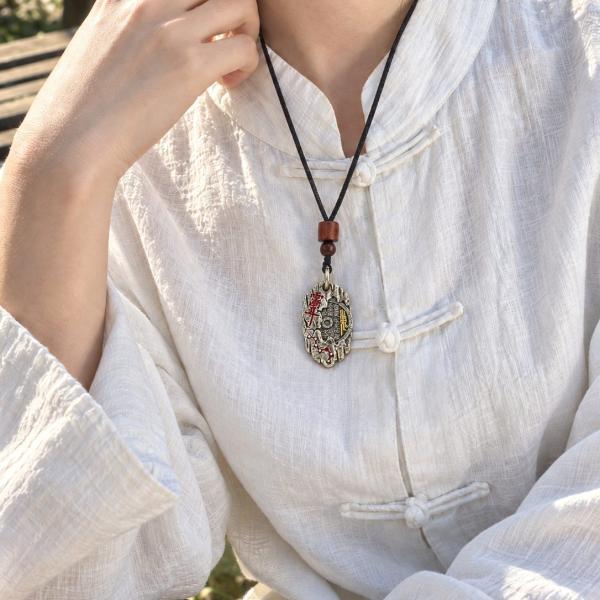
The pendant is a single piece and comes without a cord. The hole is at the top; waxed cord and leather both work, and the knot should be pulled tight so the face does not keep turning over. Diameter, thickness and weight are not listed on the page, so ask whether it sits heavy in the hand or feels light. A piece with weight to it hangs steady at the center of the chest; a light one swings off to one side after two steps. Waxed cord takes sweat better than leather and is the summer choice; leather looks better and needs replacing every two or three months.
With a piece like this, read the characters first. Deep strokes, a flat ground and straight borders mean a clean mold; shallow strokes with the lines merging into one another mean the mold has been pulled too many times. On the bagua side the yao lines should break cleanly, and where a break smears into a blur there is no point looking further. Antiquing covers some of this. Turn the piece against side light, and the eye can separate color sitting on the surface from color that has sunk into a real hollow. Old coins run red in the copper; recasts usually use brass, which looks brighter, and a dealer sees it at a glance.
White copper is cold. It sits well with a dark coat or plain cotton and linen, and looks dirty against bright red or green. If you sweat, a summer of wear puts a haze on the face that a dry cloth takes off. Do not soak it in silver dip: white copper is not silver, and the dip leaves it mottled and needing another polish. Take it off to sleep; however round the corners are, a night's pressure leaves a mark on the collarbone. A round plaque lies flatter than a square one, and a square one whose corners were never eased will press a print through a thin shirt.