


Menu
By theme
By theme



{{ variable.name }} : {{ variable.values[selectedVariantsIndex[variable_index]].name }}
Quantity:
In Tibetan tradition the great bird is the golden-winged one, Garuda in Sanskrit, and he ranks among the protectors. He is shown with a bird's head on a human body, wings spread, a snake in his beak and another coiled on his crown. The snake stands for the naga, and the combination has been painted in thangkas for centuries. In Han China people fold him in with Zhuangzi's peng, whose back is said to be who knows how many thousand li across, but those are two different systems and there is no need to force them together.
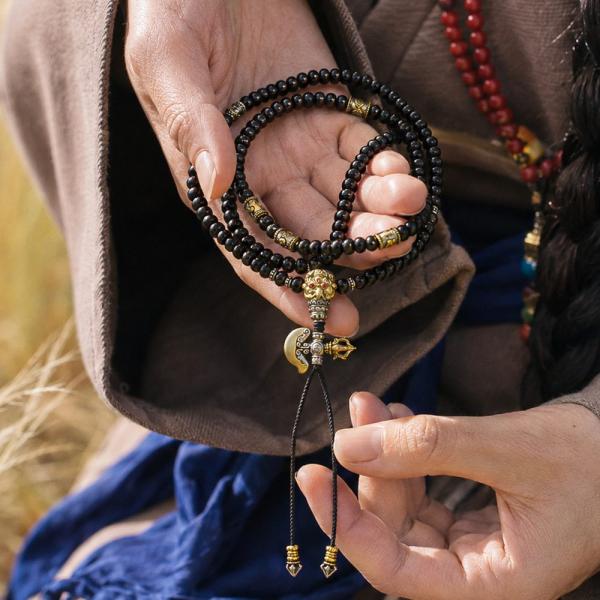
The three-hole bead is the throat of a strand. One bead drilled three ways, the buddha head below it, the main line running left and right: it sits dead center, so nothing about its workmanship can hide. When copper is used for this piece, straightness of the channels matters most. All three holes have to meet at one point; shift that point and the cord leaves crooked, and the whole strand hangs at an angle. Which piece in the set goes where is not written on the page, so ask according to how your own strand runs before ordering. The two side holes must line up; half a millimeter out and the strand twists as it goes.
The wings are the hard part. Feather plates overlap one on the next with the outer edges lifted, which depends on the thin lip left in the casting. Thin lips are brittle: drop the piece on the floor and the tips are gone. The snake in the beak is finer still, coiled twice, and the joint is where it breaks first. This is not a piece to handle every day. String it, hang it at the neck or on a bag, and take it off and knock it about as little as you can, and it will last. If the set includes a back plate, its hole has to line up with the buddha head, or you will fight it at home.
The copper is dark and steadies dark beads. Coconut shell, ebony, dark bodhi all hold it down; with South Red or amber the warm and the cold collide, and it comes down to taste. A piece with the wings open takes up more room than a round bead of the same diameter, so it reads wide in the middle of a strand; on narrow shoulders it works better at the back than at the front. Keep the disciple beads below the three-hole short. Past three fingers they tap against the chest when you walk.
Copper dislikes sweat and dislikes water. Worn against the skin in summer, wipe it with a dry cloth along the feathers once a fortnight and lift dust out of the crevices with a soft brush rather than a needle. Darkening is inevitable, and dark has its own character; there is no need to polish it back to bright. If cord wax gets into the channels, soften it in warm water, twist a cloth into a point and draw it through. Do not use flame; copper deforms with heat. Rub the antiquing too often and it thins, the color stepping back from brown to bright yellow, which is not the look it started with.