


Menu
By theme
By theme


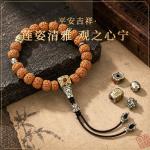
{{ variable.name }} : {{ variable.values[selectedVariantsIndex[variable_index]].name }}
Quantity:
Green Tara is the first of the twenty-one Taras, green in body, one face and two arms. The right hand turns palm outward in the gesture that grants wishes; the left rests at the heart with an utpala held between the fingers, its stem running up the arm and opening only at the ear. The right leg is extended, meaning she rises to help, which gives her a shade more urgency than the other Taras. In Tibetan painting each of the twenty-one has her own color and hand gesture, and Green Tara is the one most often commissioned on her own.
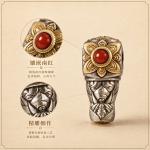
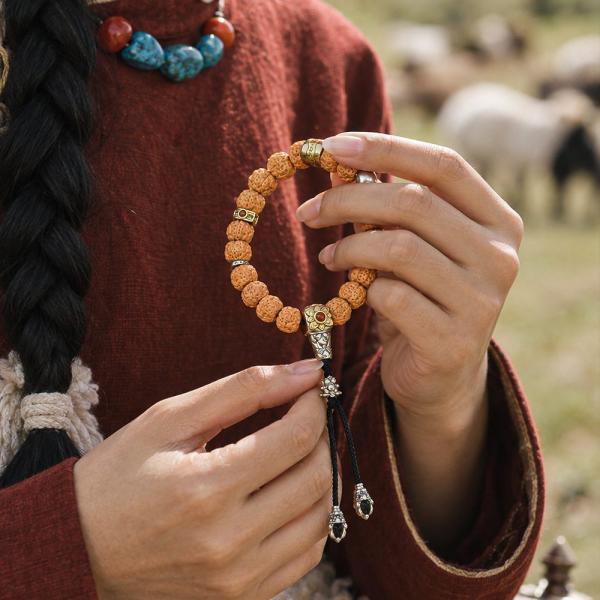
This set is for the three-hole position. One bead, three holes, the buddha head below, the main line running left and right. The Tara figure is worked on the three-hole bead, the front carrying the image and the back usually plain or with lotus petals. At small size the first thing lost is the flower stem, thin as a hair; where it cannot be cast it is left out or reduced to a raised line. Before buying, check whether the stem is still there on the piece in your hand. The three-hole takes the buddha head below, the pendant below that, and the cord to either side, so force comes at it from three directions and the walls of the holes need thickness.
The copper runs warm, and with turquoise it is a pairing in the same family: the blue-green of the stone against the dark red of the copper is how Tibetan strands are often built. With South Red it gets busy, red and green alternating, and while it draws the eye the wearer has to carry it off. Plain beads such as coconut shell or ebony set the copper off and are the safest choice. Golden copper with turquoise looks most like old Tibetan work; reddish copper with amber runs warmer. There is no right or wrong here, only the ground color of the strand.
The face is the center of gravity of the whole piece. The brows and eyes should be level and the corners of the mouth slightly lifted; a smile too wide turns vulgar. Five leaves in the crown, ribbons behind the ears: whatever can be kept is kept. A fine mold holds the lines of the face; a coarse one flattens the features, and no amount of antiquing brings them back. The five fingers of the granting gesture should be together with the joints distinct; blurred into one mass they become a block.
Copper darkens, and once it does the relief in the face reads more clearly. Some people wait for exactly that. Do not soak it to clean; draw dust out of the crevices with a dry soft brush. The channels of the three-hole have to be clear: run a thin wire through before stringing and push out any burr, and do not drag the cord through by force, because if the cord breaks the whole strand has to be restrung. If the set includes spare spacer discs, do not add them straight away; a disc too thick will tip the three-hole off square.