


Menu
By theme
By theme


{{ variable.name }} : {{ variable.values[selectedVariantsIndex[variable_index]].name }}
Quantity:
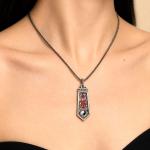
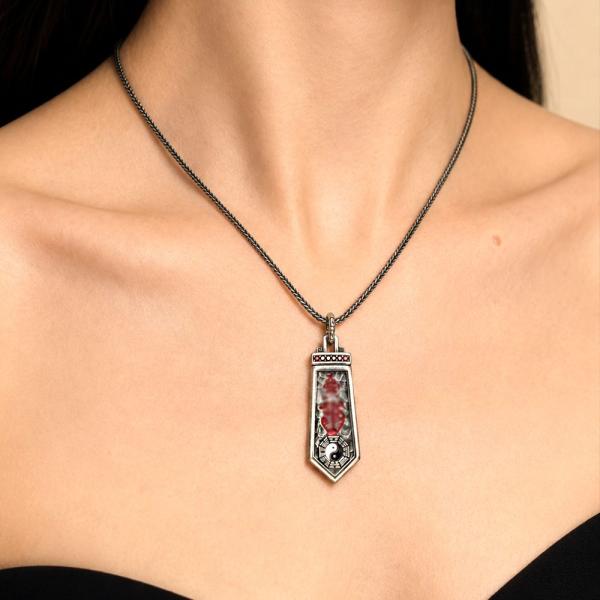
The hanging plaque borrows its form from the ritual tablet. Daoist rites use wooden and bronze tablets carved with command characters or taboo names, far larger than a pendant and meant to be held in the hand. Reduced to a size that hangs at the neck, the authority of the tablet fades and what is left is a plaque with writing on it, worn for the thought it carries. A small tablet fits in the palm and a large one takes both hands; shrunk to a pendant, the weight turns into an advantage, because it holds a collar down.
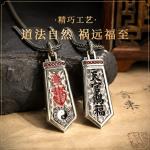
White copper runs cold, and it suits a plain face better than a busy one. Leave more open space and the characters show; cover the face with ornament and from a distance it is one mass. Plaques of this kind usually carry characters on one side and a pattern on the other, or characters on both, and the script is usually clerical or seal, squared in the stroke, which does not blur easily in copper. The depth of the cutting should be consistent; one stroke deep and the next shallow looks careless.
The border needs a chamfer. A square edge at the neck catches clothing every time you turn, while a chamfered one follows the hand. Thickness is a matter of judgment: too thin and it feels flimsy, too thick and it presses on the collar. Gram weight is not listed, so heft it when it arrives, and if it feels light, use a thicker cord to give it visual weight. Proportion matters too. Too narrow and it looks like a bookmark, too wide like a paperweight, and neither works on a body. A curved face lies against the chest better, but curve it too deeply and the characters go shallow.
With one hole the plaque turns over; with two it stays put. A single-hole plaque is held by the knot, and a knot big enough to stop the turning is ugly while a small one lets it flip. Two holes take two cords and fix the face, at the cost of having to supply the cord yourself. Check before buying whether it is one hole or two, since this detail is usually hidden in the photographs. Tie the knot between the two holes and the front stays clean.
White copper does not need to be cultivated. Worn long enough it takes on a soft, muted sheen of its own. Do not use abrasive paper and do not scrape it with a blade; scratches do not come out. Sweat left in the lettering darkens over time and looks like antiquing, but it is dirt, and a dry soft brush lifts it out. Lay it flat when it is not worn and do not stack it with other metal. This is not a piece to handle every day: white copper brightens with handling, the dark in the lettering fades, and the piece loses the very age you wanted from it. Keep the box, so there is somewhere to put it when you change what you wear.