


Menu
By theme
By theme

{{ variable.name }} : {{ variable.values[selectedVariantsIndex[variable_index]].name }}
Quantity:
In Hinduism the elephant god is Ganesha, the remover of obstacles, and he is invoked before a new venture, a journey or a wedding. He is easy to recognize: an elephant's head on a human body, a pair of large ears, a long trunk curling to the left, and the right tusk broken. There are several versions of how the tusk broke, all of them involving a pen and a scripture, and the accounts do not agree, so there is no need to insist on one. His mount is a mouse, sometimes drawn at his feet and sometimes left out; on small pieces it is basically invisible.
Carried into Tibet, this figure took another name, the elephant-trunk wealth deity, and was classed among the gods of wealth; the pose and the objects in his hands changed, the belly grew rounder, and a mongoose spitting treasure was added. The two are one in origin, and each is used according to its own rules. Before buying, be clear whether the piece in your hand is the Hindu form or the Tibetan one. They do not conflict side by side, but do not mix them when you explain it. The objects differ as well: Hindu images usually carry an axe, a lotus, a rosary and sweets, while the Tibetan ones add a mongoose.
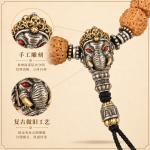
This is a fitting for the three-hole position, with the elephant's head facing outward and the trunk hanging down to cover the junction. The trunk is the finest part of the piece, curling twice with the tip turning up, and that section of the mold breaks easily in casting; a repaired spot sometimes shows on finished pieces and does not affect wear. The edges of the ears are thin and will curl if knocked, so do not store it loose with hard objects.
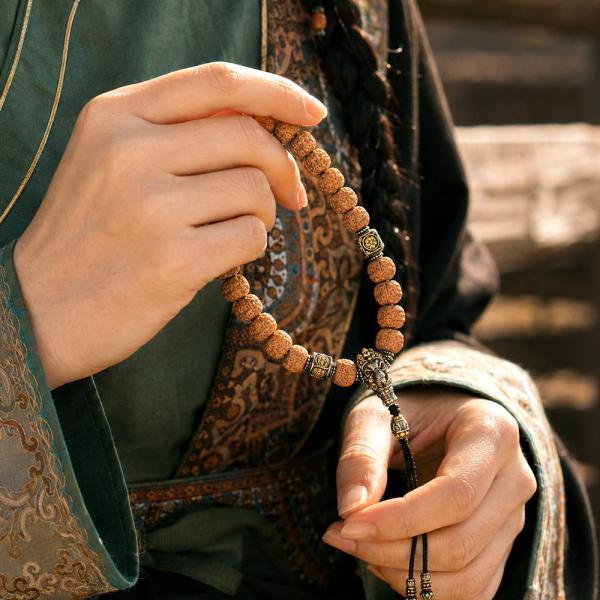
The copper runs dark and steadies dark beads. Bodhi seed, coconut shell and ebony all hold it; with turquoise or South Red the colors jump, and it depends on the tone of the whole strand. The ears are large, so the piece is wider than a round bead of the same diameter and shows when set in the middle; on narrow shoulders a side position is more comfortable. On a dark strand the warm copper lifts things a little; on a bright strand it sits down in the mix as a base.
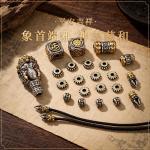
The pieces in the set are matched by position, and how they divide up is not spelled out on the page, so ask before buying. Sweat is hard on copper, so wipe it with a dry cloth after wearing it in summer. There are many crevices and dust collects in them; run a soft brush along the lines of the trunk rather than across them. Darkening is only a matter of time, and the color reads deeper when it comes; plenty of people like that stage best. Before buying a set, count the positions on your own strand. Spare pieces that sit in a drawer are still spare pieces.