


Menu
By theme
By theme

{{ variable.name }} : {{ variable.values[selectedVariantsIndex[variable_index]].name }}
Quantity:
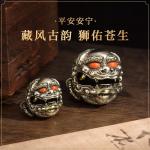
The Tang lion is the stone lion of the Tang dynasty, not the crouching pair that flank gates from the Ming and Qing. A Tang lion holds its chest up, front legs braced straight against the ground, head slightly raised, the mane curling in tufts rather than the snail-shell curls that came later. The body is lean and the muscle shows; the presence is there without fat. Lions in Tang painting look the same, tail lifted, unlike later lions that drag it behind them. Stone lions sit on a base; made into a pendant the base is dropped and the body hangs free, and the weight should fall at the chest.
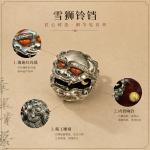
A bell at the throat is the usual pairing for this kind of lion, tied to the collar of stone and wooden lions alike. Made into a pendant, whether the bell is solid or hollow is something to ask: a solid casting is only a shape, while a hollow one with a pellet inside rings. Both are common, one to look at and one to listen to. The bell's mouth has to face down for the sound to get out, and on a pendant the mouth is mostly tucked under the chin. The solid one hangs steady and does not spin; the hollow one is light and rings, and it wears the cord through faster.
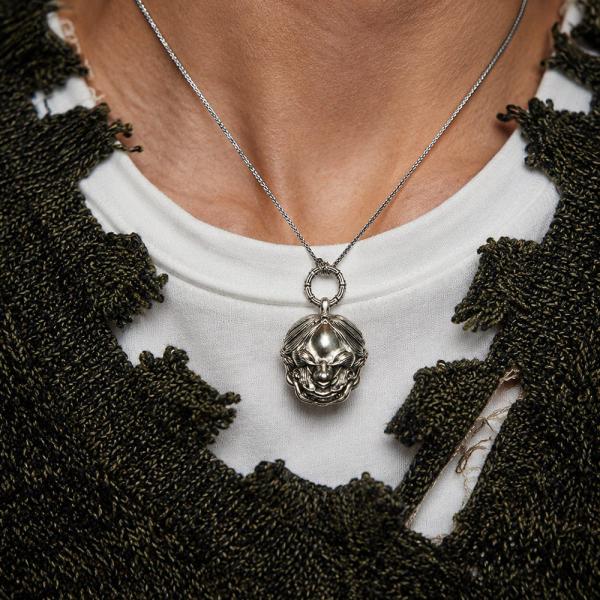
Two sizes, small and large. The small one suits the neck; the large one is better on a bag or in a car. A lion is wider than a round plaque of the same height, so on a thin neck take the small one or the pendant will tip to one side. For a car, do not choose the ringing version, because it is noisy over bumps. The difference between the sizes is height and weight, so measure where you plan to hang it before deciding.
The curls of the mane are where the workmanship shows. Well cut, each tuft separates from the next and the center of the curl is deep; cut roughly, they blur into a knot. The joint between bell and collar is the thinnest point and can come out hollow in casting, so pinch it gently when it arrives rather than pulling at it straight away. The teeth should show, but modestly; a wide-open mouth turns the lion into a beast. Leave a little space between bell and collar: too tight looks dead, too loose swings.
In folk usage the Tang lion counts as an auspicious beast, and it is not the same thing as a lion dog or a stone guardian, so do not mix them when you talk about it. The lion is not a native animal of the Central Plains; it came in from the western regions in the Han, and the Tang saw enough of them to make it this solid. Given to a friend in business, a lion says something more restrained than the pieces that advertise wealth outright. Lions stood at yamen gates and bridgeheads to guard, not to draw money, and that distinction is worth keeping straight.