


Menu
By theme
By theme




{{ variable.name }} : {{ variable.values[selectedVariantsIndex[variable_index]].name }}
Quantity:
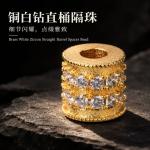
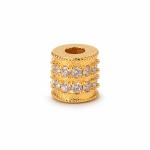
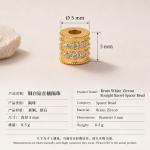
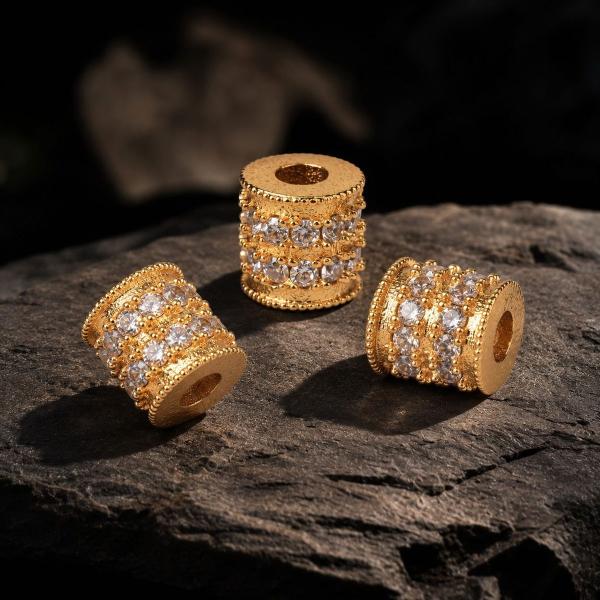
A barrel is a straight tube, flat at both ends and with no swell in the middle. Set among round beads it is a pause: when there are a lot of round things, a straight section lets the eye rest. The ratio of length to diameter decides whether it reads long or clumsy; a little longer looks elegant, a little shorter looks solid. The flat end is its signature and also where it wears cord fastest. The larger the diameter, the bigger the area of that flat ring, and the harder it rubs.
Copper base with zircon, and the stones usually run in a ring around the body or in rows of several. The body is a cylinder, so the settings have to be cut along the curve; cut badly and the stones sit high on one side and low on the other. The hole runs through, drilled from both ends, and the two bores have to meet true; off a little and the cord bends and the whole strand twists. When the drill comes in from both ends and the bores do not meet, a step is left inside the hole, and you can feel it when you thread. Set the stones close together and the copper wall goes thin, and a drop will dent it.
On a strand it has a strong sense of direction. Threaded crosswise it is a horizontal segment; threaded lengthwise it becomes a thick disc, which is rare. Between a bead and a barrel it is best to put a thin spacer disc, because the flat end of the barrel wears at the hole of the round bead and the powder collects in the gap and blackens in time. A thin disc is enough; too thick and it lifts the barrel off so it touches nothing on either side. Push each bead up tight as you string, because once the barrel sits crooked the straight line of the strand is broken.
One or two barrels are enough on a strand. At the center it is the lead; at the sides it is rhythm. Use nothing but barrels and the strand looks stiff, like a row of little tubes, and a thin wrist cannot carry it. Put a round bead between two barrels and the hardness breaks up and it reads better. A barrel longer than two fingers will press into the wrist. If the two flat ends are not parallel, you can see the gap once it is strung.
The edges of the copper need a chamfer; a square edge wears cord worst. If the hole has a burr, run a thin wire through before threading and push it out. With many stones there are many crevices, so clean with a soft brush and do not soak it, because water that gets into a setting does not come out. Store it apart from other copper when it is not worn; the flat ends of a barrel dent easily. Copper darkens even when it is left alone, and the color goes on changing in the drawer.