


Menu
By theme
By theme






{{ variable.name }} : {{ variable.values[selectedVariantsIndex[variable_index]].name }}
Quantity:
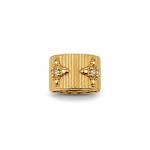
Brushed finishing and polishing go in opposite directions. Polishing chases shine; brushing chases grain. The surface of this spacer is a band of extremely fine horizontal lines, so light doesn't gather into one dead white highlight the way it would on a polished bead. Instead it spreads into a soft ribbon that shifts as the wrist moves.
Copper core set with zircon, the stone placed to one side of the body as a small granular accent rather than worked into a full ring. The diameter runs one size under the usual main bead. Its job is to separate, and to give the strand a beat so that it isn't one flat rhythm from the first bead to the last.
The advantage of a brushed face is that it doesn't show fingerprints. The disadvantage is that it holds dust. The finer the grain, the more readily it catches textile fibers, so watch it with knits and sweaters and give the piece a look before you go out. Don't clean it by rubbing in circles with a silver cloth; that flattens the grain into an uneven bright patch, and the original texture never comes back.
String them in pairs — one to each side, with a section of a different material held between — and the layering of the strand reads far more clearly than it would with a single fitting. A single one works too, but it has little presence and gets swallowed by the main beads, unless those are understated to begin with.
The copper takes ordinary care: keep it away from water and wipe it dry after sweating. Zircon shrugs off daily rubbing but not knocks. Don't toss the piece onto a tabletop when you take it off at night; hard contact chips a corner, and a chipped corner shows every time the light hits it.
There is a quieter advantage to the brushed face: fine scratches don't show. On a polished surface a single scratch is visible at a glance, while a brushed texture absorbs them into the grain. The price is that it cannot be repaired — every pass of abrasion flattens the lines a little further, so clean it gently and don't treat it as something that needs to be shined up.
If a strand is on the plain side, one brushed spacer rescues it. If the main beads are already busy, it only makes the picture noisier. The test is simple enough: when pattern takes up seven tenths of the main beads, keep the spacer plain; when the main beads are seven tenths plain, the spacer can carry some texture of its own.
Buying a pair has one more benefit. Grain direction tends to be consistent within a single batch, while two beads bought separately may run one horizontal and one vertical, and once they are strung the difference is plain to see.