


Menu
By theme
By theme





{{ variable.name }} : {{ variable.values[selectedVariantsIndex[variable_index]].name }}
Quantity:
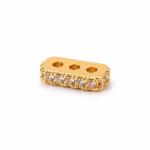
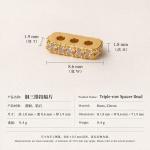
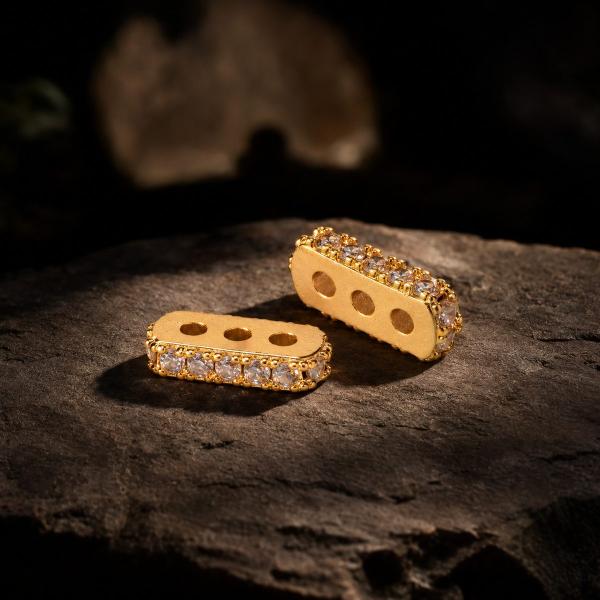
The three-row structure is, plainly, a knot where three cords are gathered into one. It is thicker than an ordinary spacer and carries three sets of holes: the cord enters left, middle and right, and comes out gathered on the far side, so the width of the strand draws in here and forms something like a waist.
In copper, shaped as a connector with granular bumps set along the edge. It does not belong in a small strand on fine cord. Three hole sets need enough cord diameter to hold their shape; with cord too thin the section goes slack, leans to one side, and leans worse the longer it is worn, until the whole strand hangs crooked.
It is usually called for on multi-strand bracelets, or on long strands that need dividing into sections. Placed at the one-third mark it gives the eye a pause; two set symmetrically work like paragraph marks answering each other across the length. A single one dead center tends to look abrupt, as if something were missing from the other side.
Copper darkens from the edges as it oxidizes, and the connector's bumps stand out more clearly against the darker ground — one good thing about copper: the pattern gains depth as it ages instead of simply looking worn. No special care while wearing. Take it off before a shower and wipe it with a dry cloth after sweating, and that is enough.
If the inside of the holes feels sharp, the burrs were never cleaned off at the factory. Sand them before you change the cord. Don't wait for the cord to fur up first, because by then the whole strand has to come apart anyway and you have lost the wear you had.
The holes must all face the same way. Reversed, the cord twists as it runs and the strand skews badly. Lay the sequence out on the table first, confirm the facing of each piece, then thread. Two minutes here beats discovering the skew at the end and taking the whole thing apart to start over.
The color deepens slowly with wear, usually over a few months rather than weeks. People in a hurry reach for chemical solutions, but the color that produces is dead and flat, less attractive than natural aging, and hard on the hands as well.
With elastic cord, be careful. Elastic stretches back and forth inside the holes, stress concentrates at the joint, and in time it tends to break at the edge of a hole. A cord with no stretch is more stable here, and easier to check for wear.
Under light the copper connector shows a brighter rim along its edge — the chamfer left by the finishing. A chamfer cut round is what keeps the piece from digging into skin, and that one detail tells you more about the work than the pattern does.