


Menu
By theme
By theme




{{ variable.name }} : {{ variable.values[selectedVariantsIndex[variable_index]].name }}
Quantity:
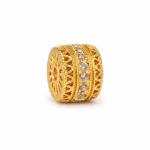
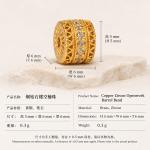
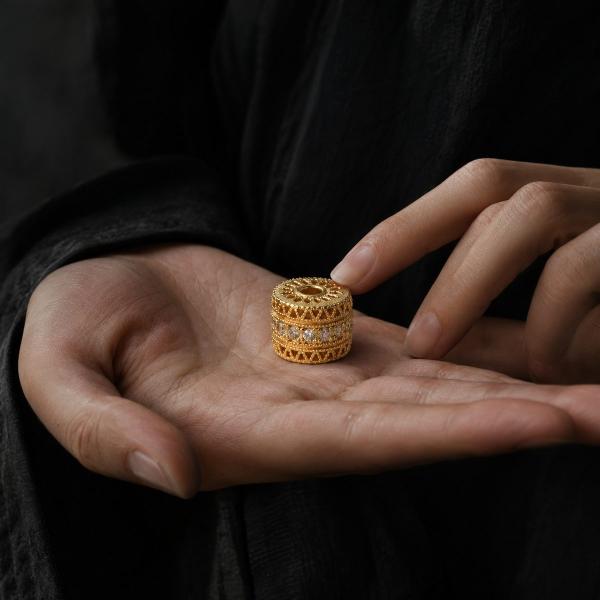
Openwork is hard to do on a small piece. The area is no bigger than a fingernail, and you have to cut openings you can see through without hollowing the structure until it deforms when pinched. It comes down to controlling wall thickness, and to knowing where to leave the metal alone. This barrel is openwork the whole way around, with white zircon set into the solid patches between the openings.
A barrel holds its orientation better than a round bead. It won't spin on the strand by itself; the openings face where you put them and stay there. That matters a great deal with openwork, because turned wrong the pattern goes out of register and the rhythm of the whole strand scatters with it.
Copper core, and the wall thickness is visible at the openings. The white zircon is small and set fairly shallow, which is fine for daily wear, but don't carry it in the same pocket as keys or coins; a knock can loosen a stone. A loose stone won't drop out at once, but it rattles, and the gap widens the longer it rattles.
It works best as the focal piece of a strand: a run of plain beads on either side, this one in the middle, and the visual weight settles where you want it. Don't put more than one in a strand. The openwork patterns fight each other, and the focus you were building disappears.
Clean with warm water and a neutral soap, then dry it at once. Water caught in the hollow does not dry easily, and over time the copper turns green; that green seeps into the seams and won't wipe out afterwards.
What openwork fears most is cord. If the edges of the openings carry fine burrs, the cord rubs back and forth there and furs up within a few months. Run a finger around each opening before stringing; anything you can feel, take down lightly with fine sandpaper. Don't press hard — the openwork wall is thin to begin with.
The pattern shows different light and shade under different light, which is why it holds up better than a solid piece over a long time. Kept in a box it is dark. On the wrist, moving, light comes through the openings and the pattern comes alive.
Openwork doesn't take antiquing well. The solution lodges inside the openings where you can't wipe it out or blow it dry, and within a few days of wearing the color starts to come back. If the inside walls of the holes look black when you are buying, that is usually the reason.
Check the flat ends of the barrel before every restringing. Copper edges fur after long wear, and a fured edge eats into the cord in turn, which turns into a loop that only gets worse.