


Menu
By theme
By theme






{{ variable.name }} : {{ variable.values[selectedVariantsIndex[variable_index]].name }}
Quantity:
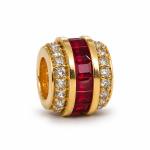
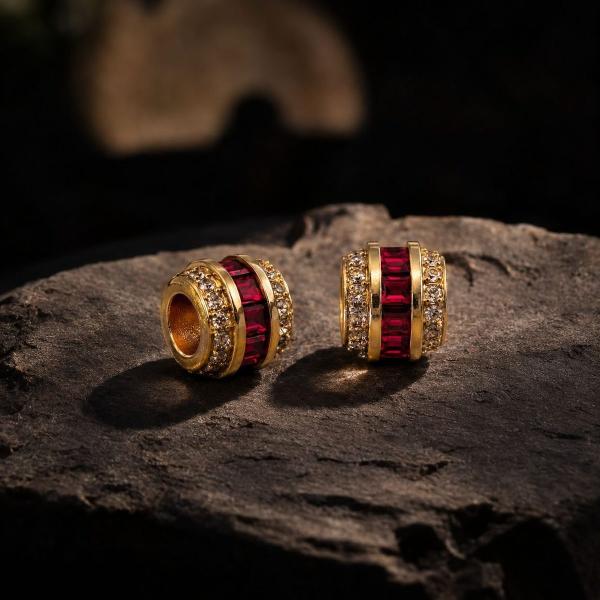
Red zircon and white zircon on one barrel bead, set in alternation: a ring of red, a ring of white, like two cords of different color twisted into one. The difference between the colors isn't large, but it separates under light — a detail you only see when the piece is close, which is exactly the sort of thing a strand rewards over time.
The barrel is straight-walled with flat ends, so it sits tight on the strand and doesn't wobble on the cord as it moves. That shape is practical for a spacer: its own weight won't flip it, and the stone-set face stays outward where it should be.
Copper base, zircon set into the wall. The red is a dark red rather than a bright one; the white is close to colorless and shows its outline by reflection. The pairing has the advantage of not fighting the color of the main beads — South Red agate, obsidian, plain silver all sit with it without jarring. When you can't decide, it is the safer choice to make.
Nothing special in the care: the usual treatment for copper, little water and a dry cloth after sweating. Zircon is hard and doesn't mind daily rubbing, but knocks are another matter. A knock against something hard chips an edge, a chip can't be repaired and the bead has to be replaced, so put it in the box when you take it off.
It looks best used in pairs, one at each end of a section so the two echo each other. A single one above a pendant also works as a transition, though you need to match the hole diameter to the cord before you commit.
The flat end serves another purpose: it lets the strand stop at a given point. Round beads feel slippery after a while, and one or two flat-ended pieces bring out the rhythm. That sense of rhythm is the most easily overlooked part of stringing, and the one that most affects how the finished piece looks.
If the gap between two barrels comes out too wide, slip a thin spacer disc between them and the strand tightens up. That adjustment needs no tools; just take it apart and restring once. It is a good deal less work than changing the whole cord.
Red and white blur into one under warm light and only separate under cool light. If you wear it mostly in rooms with warm lamps, a single color actually reads more clearly. Worth thinking about before you choose.
On dark main beads the red zircon goes heavy; against light beads the red finally jumps out. Put your main beads beside it and look before deciding — that is more reliable than judging the bead on its own.