


Menu
By theme
By theme


{{ variable.name }} : {{ variable.values[selectedVariantsIndex[variable_index]].name }}
Quantity:
The animal-mask motif is the commonest ornament on Shang and Zhou bronzes: symmetrical, a pair of large eyes holding the centre, horns at the top, a flange running down the bridge of the nose, and curled bodies spreading to either side. Song dynasty antiquarians named it the taotie, and the name has stayed in use ever since, even though no pre-Qin vessel ever called itself that. Where the motif came from and what it meant are still argued over. On a Shang square ding, a zun or a lei, the mask usually takes the centre of the belly with kui dragons flanking it.
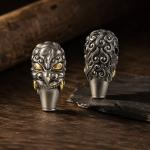
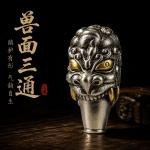
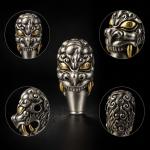
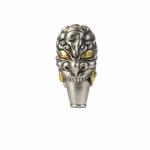
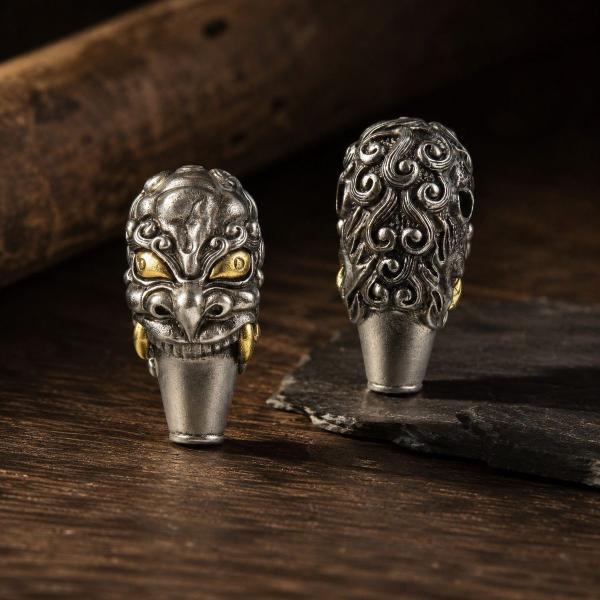
This three-hole bead presses the mask onto a small square. The two eyes fall either side of the bore, and the nose ridge is cut through by the hole, leaving only half of it. The difficulty with a three-hole bead is making the pattern step around the openings without looking as though a piece has gone missing. Seen from the side it is plain metal; only from the front is there a face. The composition has one defining trait: it is split down the middle, exactly symmetrical left and right.
Copper, with the relief carried fairly high — the eyeballs stand out and there is a distinct step where the horns begin. The patina lies in the hollows while the whites of the eyes are left bright, so they form two points of light. That works well in daylight and fails in shadow, where the whole face collapses into a block and has to be examined close up. The bridge between the eyes is the narrowest passage, under two millimetres, and it is where the chisel is most likely to chip.
The animal mask has an archaic temperament, and it goes best with old materials: rosewood, aged coconut shell, dark agate. Pale bodhi looks abrupt beside it. It is not particular about gender — it works on men and women both, though women's versions tend to put the three-hole bead at the charm position rather than among the main beads. The mouth of the bore is chamfered, so the cord is less likely to break where it turns.
The protruding eyes are the most exposed point on the piece; drop it on tile and that is what chips first. The patina dislikes acid, so no vinegar and no lemon water. A dry cloth pressed over it daily is enough, with a soft brush to bring the dust out of the seams. The copper runs red, and the patina browns it the way old pieces brown rather than blackens it. Draw a fingertip across an eye and you feel a clear arc. If the colours in the strand are too mixed the mask drowns, so keep the main beads to two kinds. On a woman's strand the charm goes below the bead and the face should look straight out. If verdigris appears in a hollow, wipe it with a dry cloth instead of rinsing, or the green will spread. Line the bottom of the box with a little velvet so the raised parts are not taking the weight.