


Menu
By theme
By theme


{{ variable.name }} : {{ variable.values[selectedVariantsIndex[variable_index]].name }}
Quantity:
Manjushri is usually shown with a sword raised in the right hand and a lotus in the left, a sutra resting on the flower. The sword is called the sword of wisdom, and it does not mean slaughter: it means cutting through ignorance. The blade is long and slender, and the point may face up or down — in thangka painting it usually points up, while in small metalwork it often points down for the sake of the composition. There is a small ring at the pommel with a ribbon tied through it, and in sculpture the ribbon is always in motion.
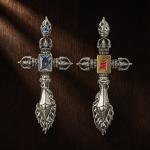
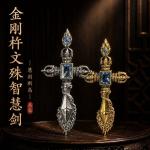
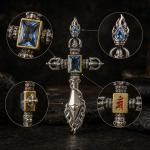
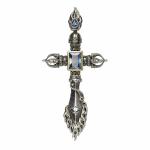
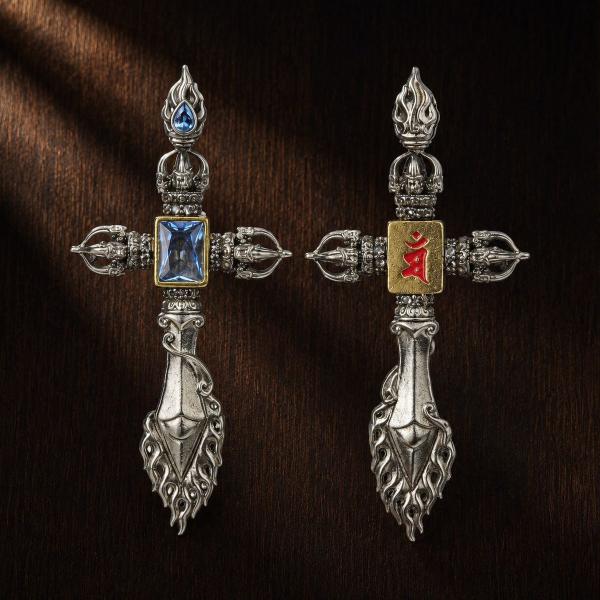
This piece puts the vajra and the sword together. The vajra is short and thick, the sword long and thin, one horizontal and one vertical, and the difference in length is what holds the composition up. The vajra sits below as a base, the sword passes up through the middle, and the hilt meets the top of the vajra. Each implement carries its own meaning; together they speak of cutting through doubt with an indestructible resolve. The blade has no fuller, only a plain face, which is also common in painting.
White copper is hard, so a long thin blade of it resists bending, at the cost of more work at the finishing stage. There are two colourways, one leaning yellow and one leaning white: the yellow is warm and close to old copper, the white is cooler and the lines of the blade read more clearly. The surface has a light matt finish, so the reflection scatters instead of glaring.
The pendant is on the long side, hanging from below the collarbone to just above the chest. A plain top is the safest thing to wear with it; embroidery or a print at the neckline will compete. It works on men and women both, and the sword is a brisk subject — given to someone studying, sitting exams or doing research, it says something more apt than most other motifs would. The back is flat with the hanging hole at the centre, so it does not look wrong turned around.
The tip of the blade is the thinnest point on the whole piece, so do not store it with keys and do not hang it on the outside of a bag. Wipe sweat off white copper, particularly at the joint between blade and vajra, where it collects. For long storage, wrap it in soft paper before it goes into a bag. Because the alloy is hard, thin sections are prone to cracking when pressed, and the yield is lower than with brass. The matte grain is very fine, closer to paper than to sand under the finger. The length falls below the collarbone, so a high collar will hide it; in winter, wear it with a lower neckline. For a student, a plain cord is better than a bead chain, which is too busy. If the tip bends, ease it back with your fingers rather than pliers.