


Menu
By theme
By theme

{{ variable.name }} : {{ variable.values[selectedVariantsIndex[variable_index]].name }}
Quantity:
A gau box is the small portable shrine of Tibetan practice: a body with a cavity, a lid that opens, and whatever the wearer decides to keep inside, whether a small image, a folded text or nothing at all. It began as something a nomadic household carried on the road, worn at the chest so that there was a place to turn to wherever the day ended. The box carries weight in Tibetan life. When a family sets out, what travels in it is not only an image but a corner of the house. That is why gau boxes are usually built more solidly than other pendants, with every edge rounded off so that nothing catches the skin.
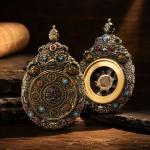
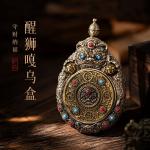
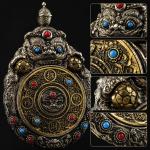
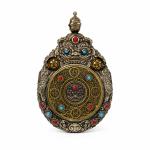
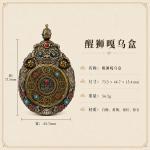
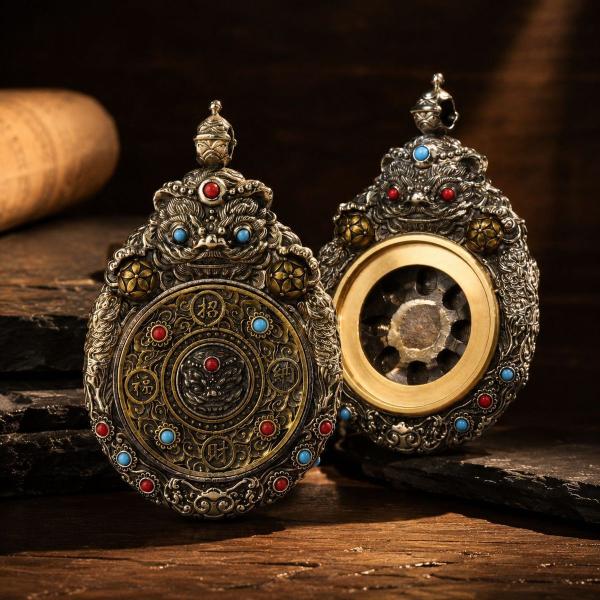
The lid of this one carries a southern lion. The awakened lion's head has a high brow, large eyes and often a single horn; it has been danced in Guangdong for centuries, and the expression at the caiqing, the plucking of the greens, turns on one word: awake. Half asleep, half roused, ready to come up at any moment. In Han China the lion head is a creature that drives off what should not be there, found on dance costumes, door plinths and eaves, and the pair of stone lions at a temple gate belong to the same line. The mane is worked in spirals, ring set inside ring. Poor work blurs them into one mass; on this piece each ring is still separate.
A Han lion and a Tibetan box put together sound mismatched, and yet they do not sit badly. The lion head holds down the square of the lid, and the depth of the box gives the head a platform, so there is a step forward and back. A plain rim runs around the edge of the lid, which keeps the mane from butting into it; that rim is kept narrow, so the head reads large. Lid and body need to weigh the same. One heavy end and the pendant tilts to that side as soon as it is worn.
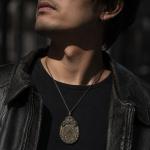
White copper is closer to silver in colour and colder than brass, so it does not fight with dark clothing and does not look worn against a white shirt. The lid fits by friction. It will loosen a little with use, which is normal wear, and only needs attention when it will no longer hold. The pendant looks best just below the collarbone, the lion facing out and the box against the body, where it cannot flip. White copper does not take sweat badly and lasts better than brass, but a summer of wear will still dull it a layer.
Mind the thickness of anything you put in the cavity. If the lid will not close, do not force it; pressed over time, the rim will distort. Take the pendant off before bathing: water that gets inside dries slowly, and copper left damp grows green spots. As a gift, the meaning here is closer to carrying a thought with you than to any claim of power, so there is no need to explain it in terms of miracles. If the person has never heard of a gau box, tell them it is a small box that holds something, and they will decide for themselves what that something is. Wearing it empty is no bad thing either. The box has a shape of its own.