


Menu
By theme
By theme



{{ variable.name }} : {{ variable.values[selectedVariantsIndex[variable_index]].name }}
Quantity:
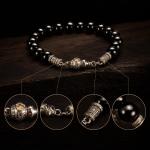
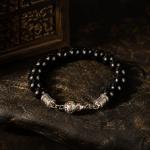
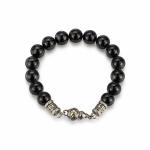
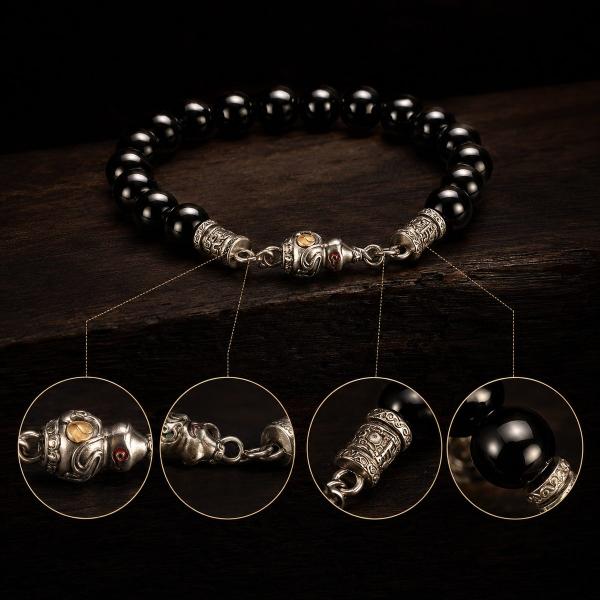
All three things in the name are on the surface: brass, obsidian, gourd. Obsidian is natural glass formed when volcanic lava cools too fast to crystallise. It breaks with a shell-like fracture whose edge can be thin enough to cut, which is why it is always worked into round beads with the corners taken off. It does not take a chisel; carving it means grinding, so fine work is beyond it, and that is why most obsidian pieces are plain-faced. The beads look black, but up close they carry extremely fine flow lines left by the moving lava, and no two beads are alike.
In Chinese auspicious speech the gourd sounds like fulu, blessing and emolument, and Daoists kept pills in them; the one on Iron Crutch Li's back is the standing example. As a shape it is made for a pendant: small above, wide below, pinched at the waist, so that a cord tied round it sits secure and it will not turn over on the wrist. The form turns up everywhere in folk objects, in wine vessels, medicine bottles and pipe weights, and putting it into jewellery amounts to shrinking a household thing down to wearing size. A well-made gourd needs tension at the waist. Soften that and it becomes a peanut.
Obsidian's black is a dead black. Light falling on it lies in a dull sheen at the surface and does not travel inward. Brass is the right partner: the metal warms with wear while the stone stays cold, and the cold and the warm held in one strand do not cloy over time. In summer, below a short sleeve, that stretch of black and yellow at the wrist carries more weight than an all-silver strand and does not look sullen. If the whole thing feels too much, let the gourd lead, use fewer beads, and let it hang onto the back of the hand.
Put spacers between the brass and the stone. The two materials differ in hardness, and without a spacer the edge of the brass will wear white marks into the obsidian. Silver or leather spacers both work; the point is only that two hard materials should not touch directly. Everyday wear is fine, but take the bracelet off to shift boxes or drive screws, because stone fears a knock rather than abrasion. Washing your hands or the dishes with a bracelet on offers more chances to catch the edge of the sink than you would think.
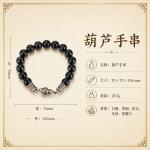
Set the fit to your wrist and leave a finger's worth of slack; too tight and it will press a mark into the skin. Obsidian chips easily when it lands on tile, and a chipped corner cannot be put back. That is its nature, and worth knowing before you buy. With elastic cord, restring every six months; when the cord goes, the beads scatter and are not coming back. Obsidian does not absorb water, so in a sweaty summer a wipe dries it, which is less fuss than wooden beads.