


Menu
By theme
By theme






{{ variable.name }} : {{ variable.values[selectedVariantsIndex[variable_index]].name }}
Quantity:
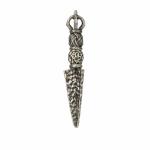
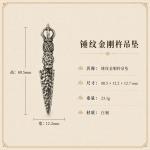
A single vajra is easier to read than a crossed one: one central prong from end to end, opening at both ends like a pair of halberds facing away from each other. The hammering falls along the prongs, the marks running with the direction of the metal, and the vertical lines draw the vajra out longer still, so that at the chest it becomes a single upright line. That vertical guidance is useful; the vajra is already a slender shape, and lines that follow it take another fraction off the width. No two hammerings are alike, and close up every piece has its dents in different places. Work from one end towards the other as you strike; going back and forth muddles the pattern, and a muddled pattern looks dirty.
Two ways to buy: the pendant on its own, or with a chain. If you already have a chain that suits, buy the pendant alone and put the saving towards a better leather cord; if you would rather not bother, take the version with a chain and wear it out of the box. On the chained version, chain and pendant are coloured together, so one will not come out darker than the other. If you buy the pendant alone, check that the opening of its bail will pass your chain; the end fittings of some thick chains will not go through.
Hammering on white copper shows its layers less readily than on brass: it is bright white, and the dark in the dents is not pronounced. So the striking here is done densely, trading density for depth. Close up it is a field of fine pitting; step back and the play of light appears. If you like a piece at a distance, take this one. If you like to turn it over in your hand, brass stands up better to close looking, because its dents gather a natural darkness that white copper does not.
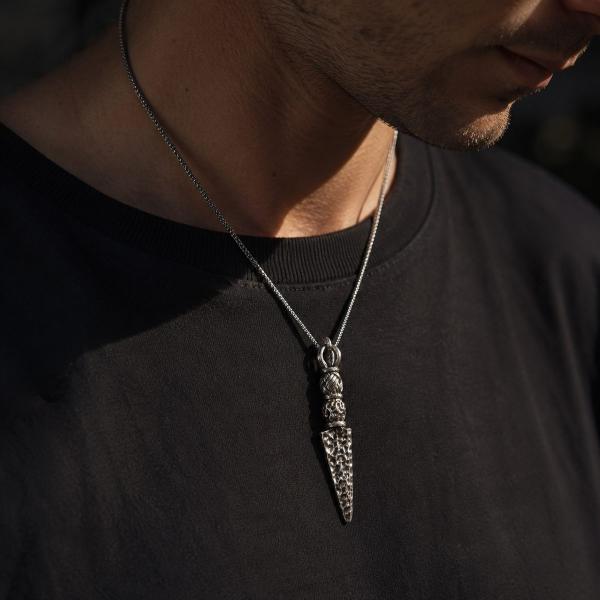
The pendant sits best just below the collarbone, point downwards, not up. Point up it looks like something being held aloft; point down is the guarding posture. There is no scriptural basis for that, only the habit handed down by older people, and you may take it or leave it. A black cord is the safest pairing, leather looks wilder, a silver chain too formal; it depends on what you normally wear. The point is rounded off, so it will not jab the collarbone when you look down.
Clean with a dry soft cloth; do not soak it in water. Copper blackens on contact with sulphur, which includes rubber bands and some rubber watch straps, so store it apart from them. Darkening with wear is normal, and a silver cloth will brighten it, but do not expect it to return to how it looked when new. That half-aged colour is, in fact, when copper looks its best. Do not keep it with keys: copper is soft and a key leaves a scratch at a touch.