


Menu
By theme
By theme

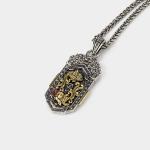
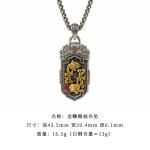
{{ variable.name }} : {{ variable.values[selectedVariantsIndex[variable_index]].name }}
Quantity:
The paired fish is one of the eight Buddhist auspicious symbols, the others being the parasol, the treasure vase, the lotus, the conch, the endless knot, the victory banner and the wheel. Together they are the eight auspicious symbols, though taking one alone is common too. The fish stands for ease: moving through water without obstruction. The order of the eight is arranged differently by different traditions, but the fish is always near the front, because it is the easiest to recognise; two curved bodies set side by side and everyone knows what they are looking at. Of the eight it is the most domestic, tied to no particular belief and no particular age. Older people read it as a sign; younger ones mostly just find it attractive.
The Han reading is different. Fish sounds like the word for surplus, so fish means a surplus year after year, and a pair means double. Koi adds another layer: li, the sound of the carp, also means profit, and the story of the carp leaping the dragon gate goes back to the Han dynasty, telling of a fish that passes the gate and becomes a dragon. The same fish is read as two kinds of good wish in two places, which is common enough in ornament. So this piece needs no explanation of whether it is Tibetan or Han: both readings hold. The word jinli, koi, only became current later; earlier pattern books still call it liyu, the carp.
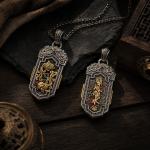
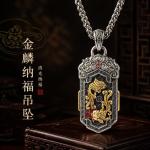
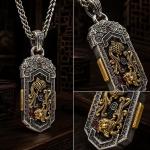
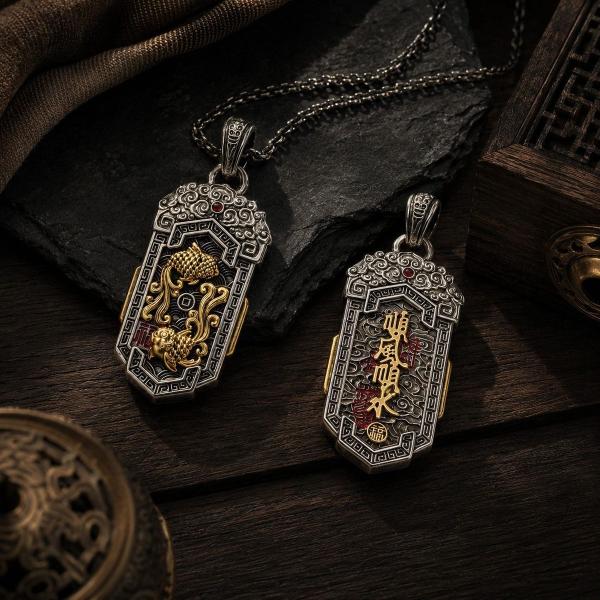
This piece puts the paired fish among auspicious clouds. In traditional ornament cloud is breath, the moving part of the sky, and fish swimming in cloud is a composition found as far back as Han stone reliefs: fish and cloud vapour in one frame, to say that this is not water but somewhere less solid. That is a more sophisticated treatment than two fish in water, and harder to make, because the cloud has to curl loosely and the fish has to swim, and the moment either tightens it dies. The bodies curve, the two face each other, and the space between them is left open. That gap is the crux; fill it in and the piece becomes a disc.
White copper has a pale ground, so the curls of the cloud and the scales of the fish are separated by the depth of the cut lines: a mass at a distance, detail only up close. That balance, form from afar and pattern near at hand, suits a small pendant. Carve it too fully and at a distance there is only a white patch and no form at all. White copper is bright, and a deep cut reads black, so the line cannot be cut shallow; shallow, and a little light wipes it out. The back is usually left plain, since it lies against the skin and needs no carving.
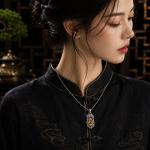
Suitable for an elder or for someone in business, and no speech is required: a surplus every year is enough. Pair it with silver or white copper rather than gold, which fights the temperature of the metal. In summer, against skin and sweat, rinse it in clean water when you get home and dry it before putting it away. The tip of the tail is thin, so do not carry it in a pocket with keys. A plain box is enough; a large red brocade box overpowers it. Chest length keeps the chain off an older wearer's neck.