


Menu
By theme
By theme




{{ variable.name }} : {{ variable.values[selectedVariantsIndex[variable_index]].name }}
Quantity:
The vajra axe is hard to describe: a crescent hook blade at one end, a vajra at the other, and a grip between them. It is not made for chopping the way a knife is; the edge curves inward and the motion is a hooking one, which is why at first glance it always seems to be missing something. The missing half is in the thangka, where it is usually paired with a bowl, one held in each hand. The curve of the blade is roughly a half circle: curve it further and it looks like a sickle, less and it looks like an axe.
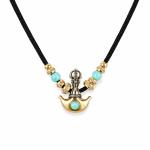
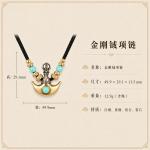
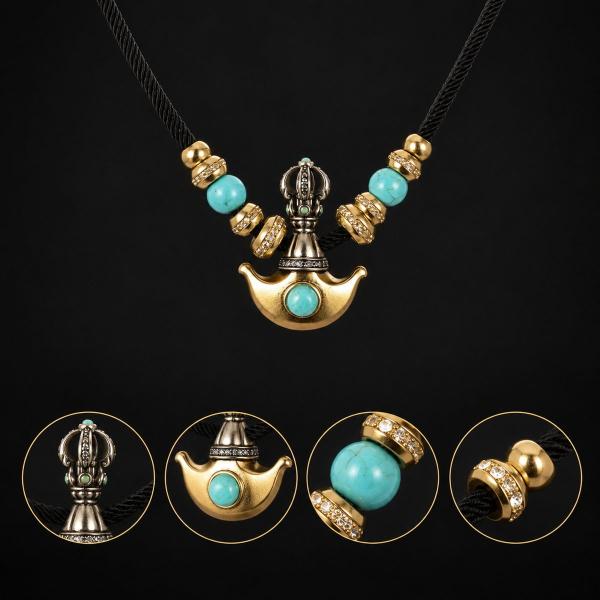
In thangkas it mostly appears in the hands of protectors or dakinis, paired with a skull cup of blood, method in one hand and wisdom in the other. That meaning is heavy, so made into a pendant it keeps only the shape of the axe and leaves out the partner; worn on the body, it need not frighten anyone. With the partner gone the outline of the axe becomes clearer instead: the arc of the blade, the straight of the vajra prong, the waisted transition between them, three parts in one breath. The transition between prong and blade is where the craft shows most; turn it too sharply and the line dies.
All a maker has to do is account for those three turns; everything else can be left out. The edge cannot be made too thin, or it will curl after two wears, and it cannot be too thick, or it stops meaning an edge. This piece keeps a ridge along the back of the blade, and the light runs along it, so that at a distance there is a bright line holding the sense of sharpness. The ridge also acts as a brace, so the thin part does not collapse under a press.
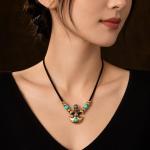
Necklace length follows the neckline. A round neck or a V will both hold it down; with a high collar, do not wear it, because the pendant pushes against the cloth and swings with every step. The pendant is on the thin side and rarely turns over, but choose a clasp that swivels, or in two wears the chain will twist into a rope. A black cord suits this piece better than a silver chain: the shape is hard enough already, and a bright chain on top of it is too much. Do not make the chain too long, or the pendant swings below the chest and knocks against you.
White copper does not need frequent polishing; polish it too often and the dark is washed out of the hollows and the layering goes with it. When it does need cleaning, use a silver cloth on the raised surfaces only and leave the hollows. In the drawer, keep it in a felt pouch: the hook of the blade will scratch other things and be scratched by them. Wear it point down; point up, in a crowd, it catches on scarves. White copper yellows slightly with long wear, which is the copper showing through, not the finish coming off.