


Menu
By theme
By theme

{{ variable.name }} : {{ variable.values[selectedVariantsIndex[variable_index]].name }}
Quantity:
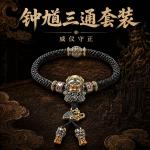
Zhong Kui's origin is legend, and there is more than one version. The best known is Tang dynasty: a man of Zhongnan Mountain, a fine scholar, struck from the palace examination for his looks, who in his fury dashed his head against the steps and died. Later Emperor Xuanzong, ill, dreamed of a great ghost devouring a small one, which named itself Zhong Kui and offered to rid His Majesty of hauntings; he woke cured. The emperor had Wu Daozi paint the image, and the type was fixed from then on: leopard head, ring eyes, coiled beard, black cap. The story may not be true, but the picture has been passed down for more than a thousand years, from murals to New Year prints to wood carving and brass.
Folk use divides him between two seasons. At Duanwu his image is hung to drive off the five poisons; at the year's end, when the door gods are changed, he is pasted up too. One deity covering two festivals is unusual in folk belief. In paintings he usually has a sword under one hand and a ghost in the other, though there are comic turns as well, such as the drunken Zhong Kui or Zhong Kui marrying off his sister, the latter more popular in New Year prints because it is livelier. On a strand he is usually the main piece at the finish, one bead holding down the whole; face outwards, not the back of his head to the room.
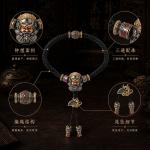
Making Zhong Kui into a three-hole bead is a mix. The three-hole bead belongs to Buddhist rosary finishing, and Zhong Kui belongs to Daoism and folk belief; the two systems do not connect. Observant people will mind, and those who do not mind are after the expression on that head. Such mixing is not rare among collectors of curios: Guan Gong, pixiu and bagua have all been put on three-hole beads, and the stringer only needs to know what they are doing. Zhong Kui's face is hard to do in brass: the eye sockets must be deep and the beard separated into strands, or what comes out is a lump.
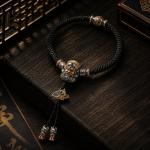
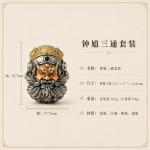
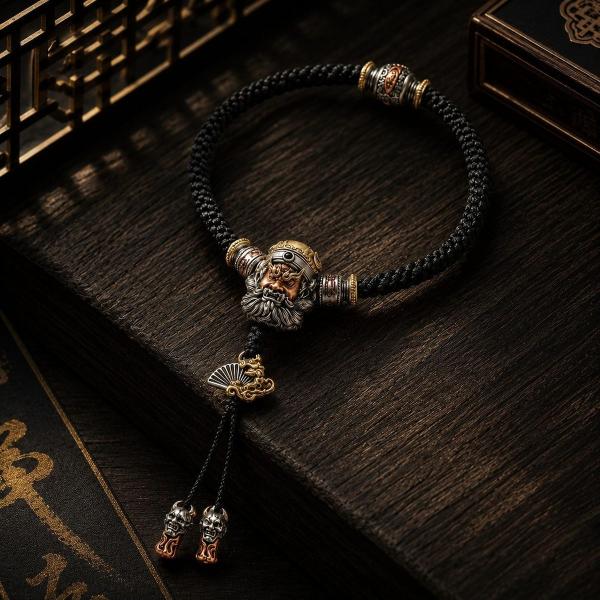
On this one the brows and eyes are set low, the beard is parted into locks, the cap takes the upper half, and the channel runs out through the side of the cap. Brows low and the ferocity arrives; beard parted, and at a distance there is a beard, and close up it does not blur. The channel goes through the side of the cap so that the face in front stays whole, uninterrupted by a hole. The cap follows the black gauze official's hat, its wings not spread outward, so they do not steal from the face. The opening at the base is smoothed, with no burr to feel. A shallow groove is left between the brows, and when light comes at an angle that groove goes black.
The natural colour of brass, unplated. With long wear a dark layer gathers in the seams of the beard, which reads as ink and has more character than a polished shine. If it bothers you, wrap a cloth round a toothpick and follow the locks. On dark wooden beads or aged bodhi seed the ferocity of Zhong Kui is held in check; on pale beads the darkness in the face looks merely dirty. Once the brass has dulled, the black and white of the face actually reads more clearly. As a gift this one is choosy about its recipient: best for someone who likes folk custom and enjoys opera.