


Menu
By theme
By theme

{{ variable.name }} : {{ variable.values[selectedVariantsIndex[variable_index]].name }}
Quantity:
Green Tara's posture is her mark: the right leg extended, the sole resting on a small lotus, the left leg folded. The pose is called half cross-legged, and it means she is not settled but ready to rise. Of the twenty-one Taras, only she makes the movement so plain. Looking at a thangka, read the legs first and the hands second, and you will hardly mistake her. Her body is green, the green of new leaves rather than the heavy green of jade. The colour is her identity; change it and she is someone else.
Her hand gestures are as easy to read. The right hand hangs down, palm outward, in the gesture that grants wishes: what you ask for, I give. The left holds the stem of a utpala at the chest, the stem passing round the wrist, the flower opening at her left ear. The utpala is the blue lotus, and there are three: one fully open, one half open, one still closed. The three answer to past, present and future, and to Buddha, dharma and sangha. This detail is often dropped on pendants; few are made complete.
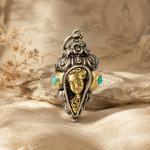
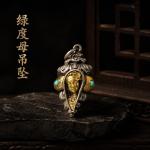
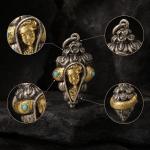
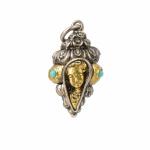
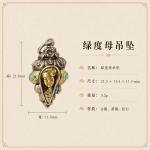
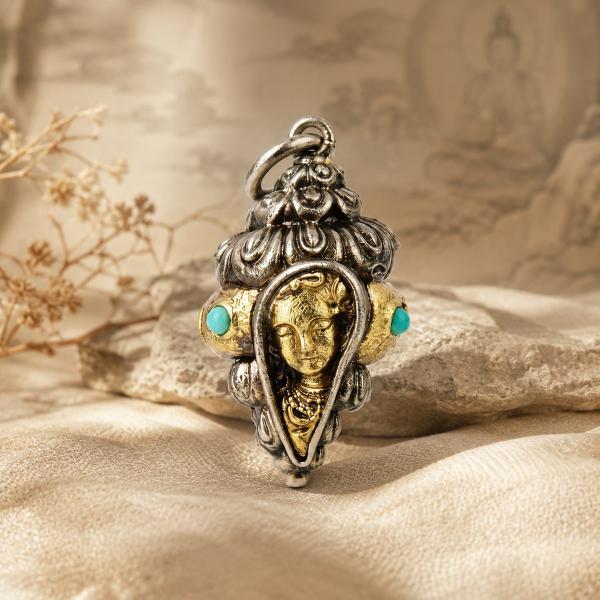
This pendant takes the upper body only, leaving out the legs: what remains is the crown, the gestures and the flower. The flower is the easiest to know, three blooms rising from beside the ear like a string of beads hung there. The crown has five leaves, for the five directions. With the legs gone the weight sits at the chest, and the pendant does not turn over as it might if the lower edge were too wide. Such choices are forced by the pendant form rather than being a casual simplification. The flower stem is the finest part of the piece; do not press on it when putting it away.
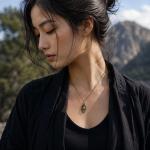
White copper's cool tone against the skin looks plainer than brass. It holds against Tibetan red or deep blue, and is not out of place with a white shirt. Use a fine chain; Green Tara's form is light already, and a thick chain would weigh it down. At chest length the flower sits just below the collar. The back is usually plain, with only a horizontal strengthening rib, since the side against the skin needs no ornament. In summer, against skin, copper leaves a slight mark, which washes off.
As a gift, the Green Tara subject leans towards things going smoothly; say that much and no more, and do not promise too much. Whoever wears it knows what they are asking for. Take it off for the bath, since copper dulls when it meets soap. If it is not worn for a while, bag it rather than leaving it open on a windowsill. In Tibetan understanding Green Tara's vow is the most urgent, which is why so many ask her; I offer that as a story only. Avoid a plastic box: copper in trapped damp will bloom with spots.