


Menu
By theme
By theme


{{ variable.name }} : {{ variable.values[selectedVariantsIndex[variable_index]].name }}
Quantity:
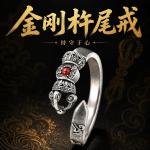
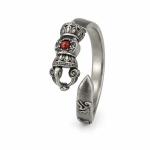
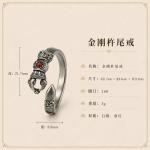
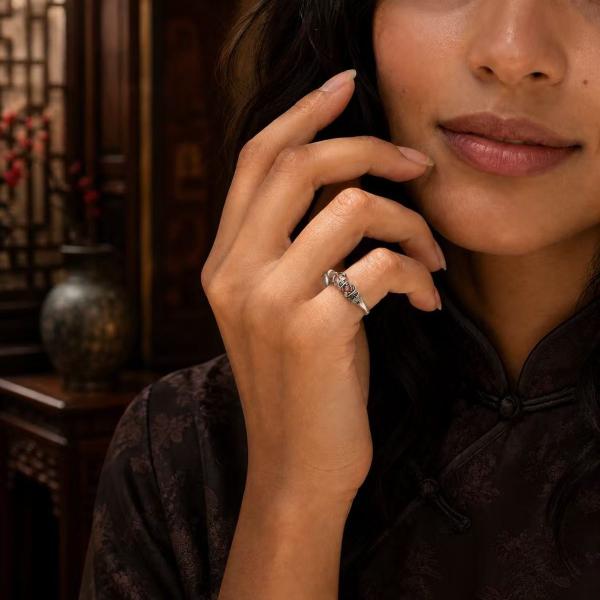
A pinky ring sits on the last joint of the little finger and runs a size narrower than an ordinary ring, so the body of the vajra here is made narrow, its long side following the circumference rather than spreading sideways. A vajra cannot be scaled down in proportion on a little finger; shrink it and the prongs crowd into a knot. Narrow and long is the only solution. The little finger moves less than the others, so a heavier piece is less tiring there, which is also why the pinky ring has often been made to carry a point. In older custom there are other readings: one that it is for self-defence, another that it reminds the wearer not to spend freely.
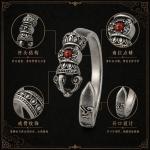
The open design means it does not insist on a size. Anyone whose measurement falls between two sizes can bend it to fit; fingers swell in summer and shrink in winter, and one ring will see out the year. The gap is left at one side, and the two edges must meet evenly when closed; offset them and the vajra's shape breaks. The old trouble with open rings is that they catch knitwear, so wear it with the gap towards the palm and you halve the chances. If your knuckle is thick, the widest the gap will open may still not clear it, so measure first.
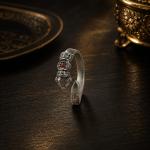
On a face this narrow the vajra can keep only three prongs: the centre one a little higher, the outer two pressed down, so that a sweep of light brings out the bright line between them. The lotus seat is dropped, with a single horizontal ridge standing in for it. The two ends of the vajra sit at the sides of the finger, one towards the back of the hand and one towards the palm, and only turning it shows the whole. However fine the work, a face this narrow on a little finger can only give the general shape; what reads is the run of that centre prong.
White copper is pale and inconspicuous on a little finger, which suits anyone who would rather not have what they wear noticed at a glance. It goes with silver rings or a leather cord; do not stack it on the same finger as a large brass ring, where the warm and the cold fight. On a small hand a pinky ring can look empty, and it can move up to the second joint of the ring finger and be worn as a knuckle ring. Which hand is a matter of local custom; what suits your own eye matters most.
When opening it, press both sides together rather than one, or it will twist out of line over time. If it does twist, do not force it back; copper springs, and bending past the point leaves it loose. Rinse it when you wash your hands, since soap gathers in the gap. As a gift this kind of piece is not fussy about the recipient, because there is room in the sizing. Ask which hand they wear rings on first; some people will not put a pinky ring on the left. Copper takes on a thin film of dullness with use, and polishing it or not is up to you.