


Menu
By theme
By theme



{{ variable.name }} : {{ variable.values[selectedVariantsIndex[variable_index]].name }}
Quantity:
The seven stars of the Northern Dipper have had their names a long time: Tianshu, Tianxuan, Tianji, Tianquan, Yuheng, Kaiyang, Yaoguang. The first four make the bowl and the last three the handle, and since the handle points in a different direction through the year, the ancients used it to fix the solar terms. The names appear in texts from before the Qin, and Daoism later took the whole set over and made it the frame of its star worship. Watching the handle was a matter of farming: when to sow and when to reap, read by looking up. The handle turns thirty degrees a month and comes full circle in a year.
Daoism takes the Dipper seriously, holding it to be bound up with a person's allotted span, and Doumu is described as the mother of the Dipper's stars. That is a statement of belief, and belief is up to the individual. In folk use the Dipper was embroidered on bed curtains and cut into the backs of mirrors, for the sense that a star was watching over. That kind of use is more everyday than temple ritual and freer with the rules. In Daoist liturgy the Dipper also carries a full set of titles, each star lord with his own charge.
The two characters gu lu take in grain and salary: gu is the harvest, lu the official's stipend, and together they say that food and clothing are provided for. Put together, they are more restrained than simply saying summon wealth. Summoning wealth asks for more; grain and stipend asks for steadiness, and the two tempers are far apart. Give one as a gift and the difference registers. The word gu lu is rare now, surviving on old ledgers and old signboards. More people want steadiness than want speed, and these two characters are for the former.
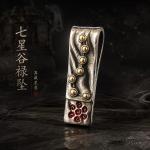
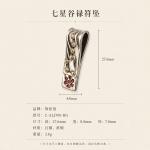
The seven stars are laid out on the pendant in the shape of the dipper rather than at their astronomical positions. The dipper shape is easy to read and holds the face. A true star chart is too scattered, and reduced to a small piece it is only a few dots with nothing to recognise. So pieces of this kind are made as signs, not as maps of the sky. The seven stars are all the same size, with no principal among them, which is where this differs from other star charts.
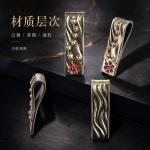
The stars are cut as recessed points, dark when the light comes from above and bright only when seen from the side. That contrast shows most under indoor lighting. Pair it with a black cord and the points are left undisturbed. The seven must be the same depth; if one is shallow the field falls apart. The edges of the recesses must be sharp; rounded off and they blur, and this is the easiest thing to overdo when polishing.