


Menu
By theme
By theme


{{ variable.name }} : {{ variable.values[selectedVariantsIndex[variable_index]].name }}
Quantity:
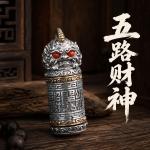
In Han usage the five directional wealth deities are Zhao Gongming and his four subordinates: Xiao Sheng, the Heavenly Worthy Who Summons Treasure, of the east; Cao Bao, the Heavenly Worthy Who Gathers Precious Things, of the west; Chen Jiugong, the Envoy Who Summons Wealth, of the south; and Yao Shaosi, the Immortal Official of Profit, of the north. In the centre is Zhao Gongming, from the system of the Investiture of the Gods. Four hold the four directions and the centre sits at command, which is a small order in itself. The four names, summoning treasure, gathering precious things, summoning wealth and profit, name four hopes of trade.
Tibetan practice has a different set of five Jambhalas: yellow, white, red, black and green, differing in body colour and each with its own emphasis among vows. Both sets are called five, and their origins do not connect, so do not run them together. When you cannot tell them apart, look at whether the central figure rides a tiger: Zhao Gongming does, the five Jambhalas do not. That mark is more use than memorising names. Of the five Jambhalas the yellow is the commonest, crowned and also holding a mongoose.
Five figures on one pendant can only be arranged in two rows or in a ring, with the central one as the principal. Look at who is in the middle and you know which system the arrangement follows. Crowded together, the danger is blurring, so each figure needs a channel left between it and the next. In two rows, three above and two below with the centre figure in the upper row; in a ring, the principal at the centre. The two-row arrangement is easier to read than the ring, since the principal is found at a glance.
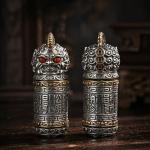
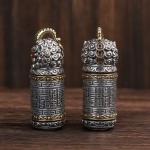
White copper has a pale ground, and five figures crowded together blur easily, so the dividing lines do the work. The lines must be deep; shallow and it becomes one field. In a piece with this many figures it is better to lose a detail than to lose a figure's outline. Lose the outline and the five become a bank of cloud. The divisions are cut intaglio, and after cutting a bright edge is pressed in, or the lines blur. Each of the five holds something, a treasure, a whip, a sword; mix them up and the figures are misread.
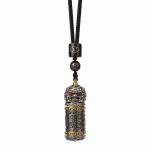
For someone in business this is a more solemn gift than pixiu alone: pixiu is one beast, the five are a company. It can hang in a shop as well, and takes less room than an image on the counter. Clean with a soft cloth rather than a brush; where dust gathers in the channels between the five, lift it with a toothpick. If it hangs in a shop, do not set it directly facing the door; a little to one side is safer. When white copper is bright the five faces brighten together and are less distinct; dulled, they separate.