


Menu
By theme
By theme




{{ variable.name }} : {{ variable.values[selectedVariantsIndex[variable_index]].name }}
Quantity:
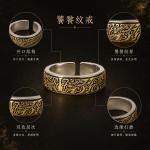
The taotie motif is the name Song scholars gave to the animal-mask patterns on Shang and Zhou bronzes. The Lüshi Chunqiu says that the Zhou cauldrons bear taotie, a head and no body, and following that sentence the Song called every pattern with a face and no body a taotie. The Song loved antiquity: they compiled catalogues, traced images and fixed names, and a great many bronze vessel names were settled then. The Xuanhe Bogu Tu, compiled in the Song, drew a great many Shang and Zhou vessels, fixed their names and fixed what later ages called them. The drawings in that book have traced lines and guessed forms, and yet the names came down as they were.
Scholars later found that patterns of this kind go back much earlier than the Shang, and whether they are taotie is in doubt, which is why excavation reports now mostly say animal-mask pattern. The name taotie was stuck on afterwards. Late as the name is, the gravity of the pattern is not in doubt: on a Shang or Zhou cauldron it is the principal. The craftsmen of the period may not have had taotie in mind; what they cut was a beast those around them knew.
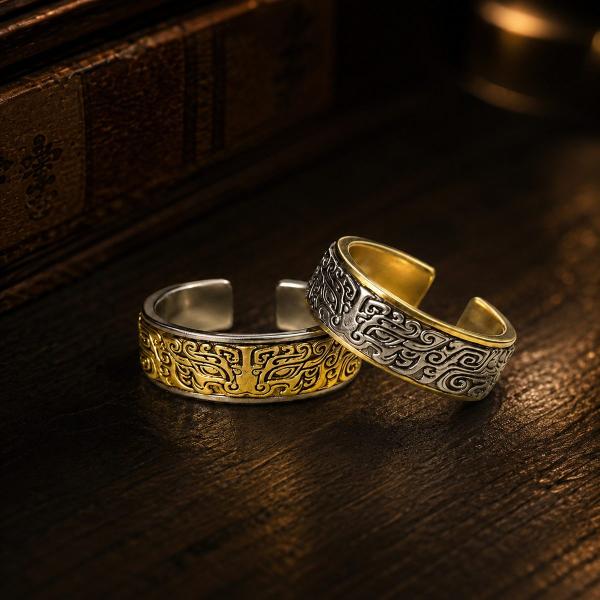
The animal mask is built sturdily: one axis, symmetry either side, the great eyes at the centre, the horns above, the bridge of the nose running down. The more it is simplified, the more it depends on those few things. Reduced to two eyes and a pair of horns it is still recognisable, and that is the strength of a frame. The two eyes are the weight of the whole pattern; get the proportion wrong and the face goes crooked. Horns take several forms, ox, ram and feather, and the horns are how a date is read.
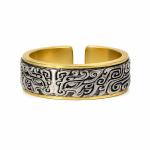
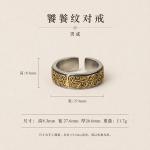
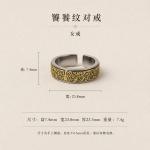
The pair divides into a man's ring and a woman's, the man's wide and the woman's narrow, the same pattern at different scales. Same design and different widths is what makes them read as a pair rather than two identical rings. When scaling, the proportion of horn to eye has to be recalculated; simply reducing the drawing distorts it. The man's band is thick and the woman's thin, and set side by side the difference is plain. On the woman's ring the pattern has to be drawn in, and after drawing in the eyes must still be kept large, or it becomes mere ornament.
Sweat gathers in the recesses of white copper, the deeper the pattern the more readily. Once a week, warm water with a little mild soap and a soft brush along the lines, then rinse and dry. Worn together, do not put them on neighbouring joints of the same finger, where they will rub. When not worn, lay them side by side in the box with a cloth between. Do not scrape the old colour out of the channels with anything hard: copper will not take it, and one scrape leaves a white mark.