


Menu
By theme
By theme

{{ variable.name }} : {{ variable.values[selectedVariantsIndex[variable_index]].name }}
Quantity:
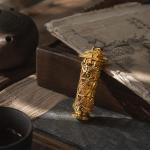
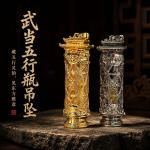
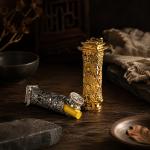
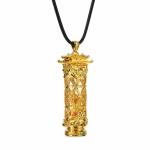
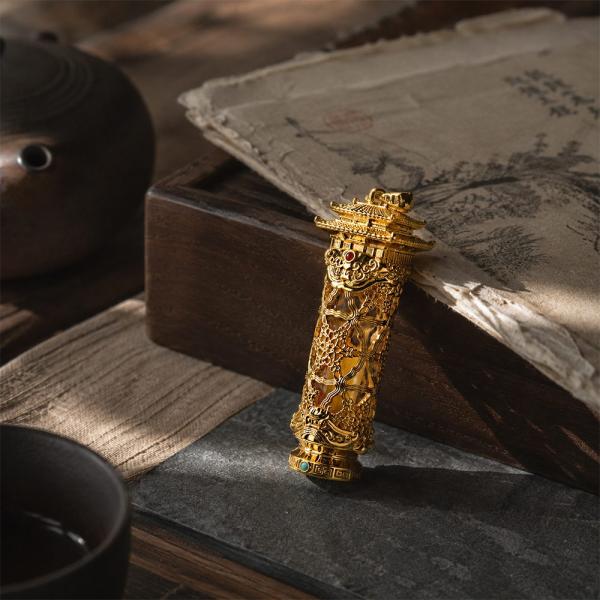
The vase appears very early among Daoist ritual implements. Alongside the seal and the sword, the precious bottle was mostly a vessel for water or elixirs, a working object on the altar, and only later turned into a motif. Wudang Mountain is dedicated to Zhenwu, and in the ritual inventory of its temples the vase is one of the common classes: tall ones and short ones, lidded and open, with rims thick or thin. This pendant follows one of the slimmer forms, with a band of five-element symbols wrapped around the belly, gathering metal, wood, water, fire and earth inside a small outline.
The five elements are not five materials but five states of movement. Wood governs growth, fire governs rising, earth governs bearing, metal governs gathering in, water governs descent; neighbours generate one another, and those a place apart restrain one another. On the body of the vase they are set in a ring, which carries the sense of unending circulation rather than a bet on any single phase. Rings of this kind turn up in the borders of temple murals and around talisman frames, only shrunk here to pendant scale: from a distance a band of fine lines, and the characters only once you are close.
The five elements also map onto directions and seasons. East is wood and spring, south is fire and summer, west is metal and autumn, north is water and winter, and the centre is earth and late summer. Physicians, musicians and military men of the old order all borrowed this framework to talk with, with the five organs, five colours and five tones each given their place. Laid out as a circuit, it amounts to that diagram compressed into the palm of a hand. Worn on the body it works as a reminder that any question has five sides to it; it need not be read as a charm.
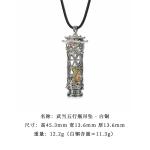
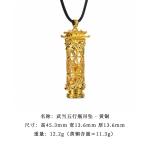
Yellow and white are two separate styles, and the difference in tone is more obvious in the metal than in photographs. The yellow is warmer and stands out better against dark clothing; the white is cooler and, worn against the skin for a while, settles down towards the tone of old silver. Copper changes colour when it meets sweat and air. That is the metal reacting, not a fault, and it will not wipe back to the way it left the workshop. If you do want to look after it, go over it with a dry cloth, do not soak it, do not use polishing paste; the layer you cut away does not grow back.
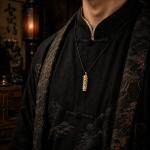
The profile is on the slender side, and it looks better worn alone than stacked, better on a fine chain than on a thick cord. To make it a car charm or a bag charm you would have to change the bail yourself, since the ring it comes with will not necessarily pass through. We send the pendant body only by default, with chains and cords supplied separately as needed; check the inner diameter of the bail against your own chain before ordering, which saves a good deal of fuss compared with sorting it out after delivery. If it is meant as a gift, a vase is a safer shape than a Buddha figure, as it makes no demands on what the other person believes.