


Menu
By theme
By theme





{{ variable.name }} : {{ variable.values[selectedVariantsIndex[variable_index]].name }}
Quantity:
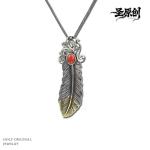
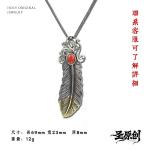
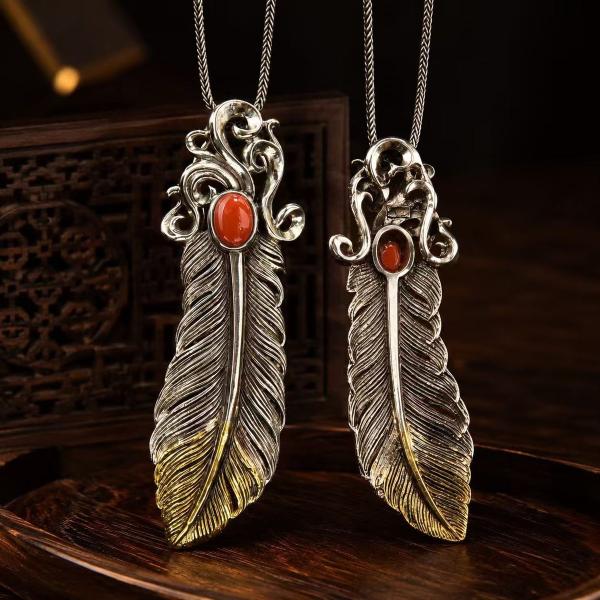
Feathers are a common decorative motif in Tibetan areas, with arrow feathers, eagle feathers and peacock feathers each carrying their own reading. This one takes the outline of a single feather, a central shaft running the full length, barbs fanning out to either side and narrowing at the tip. Made into a pendant it is long and vertical, and the eye travels downward, so on the chest it draws the gaze with it; it sits more easily with a V neck than a round one. The spacing of the barbs is the crux: too dense looks clumsy, too open looks empty, and the gaps between them need to be even. The back of a feather is usually left flat with the detail worked on the front, so turning it over tells you which side is which.
South Red is one of the red agates, running from persimmon red to cherry red, and it was often used for inlays and beadwork in older pieces. Red against white is very common on Tibetan objects — red coral with silver, South Red with white copper — and the logic is the same: a little saturated colour lifts the whole tone while the rest is left plain. The same trick appears in the borders of thangkas, and after you have looked at enough of them it becomes obvious.
White copper forms the shaft, with South Red set at the root or the tip, one cool and one warm set against each other. Where the stone sits decides the balance of the piece: high up reads light, low down reads steady. Small inlays of this kind are vulnerable to knocks, and the tip of a feather is fine, so store it separately rather than tangled in a bag with other jewellery, which is fiddly to undo and easily bends a barb. South Red is harder than copper, and if the seat of an inlay is not level the load falls on a single point and the stone chips. Where an inlay is glued rather than set, heat is the enemy, so do not leave it in a car in summer.
Worn point down is the usual way, and a shorter chain is crisper, with the length landing just below the collarbone. On a long chain it turns with movement and both faces show, so the finish on the back matters too. It looks best over a dark jumper; a white or cream top cannot carry that little bit of red and tends to look grubby. The clasp is best centred at the back, so that the feather does not drift to one side.
The red of South Red is never even; there are light and dark passages within a single piece, some with water lines, some with fine veining. These are natural marks rather than faults, and if you are after two that are exactly alike, that is the thing to be wary of. Once the white copper darkens, the contrast between red and white grows deeper and less jumpy, which is why plenty of people find it looks better after six months of wear. If hand cream gets onto the copper, wipe it off with a dry cloth before putting the piece on.