


Menu
By theme
By theme


{{ variable.name }} : {{ variable.values[selectedVariantsIndex[variable_index]].name }}
Quantity:
The vajra began as a weapon in ancient India and later became the emblem of Buddhist ritual implements. Vajra means indestructible, and the absorption Shakyamuni entered at enlightenment is called the vajra-like absorption, which is how the vajra came to stand for breaking through affliction. In tantric practice the vajra is paired with the bell, one standing for compassion and one for wisdom, and the two are not used singly in ritual. Once that pairing reached China it was often simplified to the vajra alone, and for everyday wear there is no need to be strict about it. The grip has its rules in ritual — thumb pressed to the middle section, fingers not splayed — and these are still visible in the murals.
Vajras are classed by the number of prongs: single, three, five, nine, symmetrical at both ends and waisted in the middle. The more prongs, the denser the outline and the harder the work. At pendant scale three or five prongs are usual; nine only opens out on a large implement, and shrunk to a small piece it smears into a lump that reads as a knot from a distance. The gaps between the prongs are the first thing to get filled in on fine work, and once filled the piece loses its openness. This is where the skill shows.
The cool tone of white copper sits more steadily with a dark cord; red is possible, but red pulls attention away from the figure. The tips of the prongs are the most exposed spot, so keep the pendant out of a pocket shared with keys and coins. Copper darkens with wear; a dry cloth is enough, and no abrasives, because a layer taken off does not come back and the detail in the recesses flattens with it. The knot goes above the Buddha's head, with two fingers of cord left over, which hangs about right.
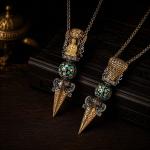
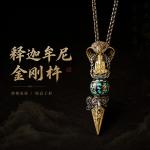
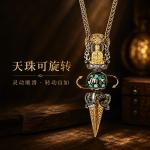
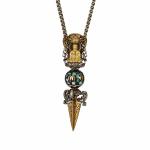
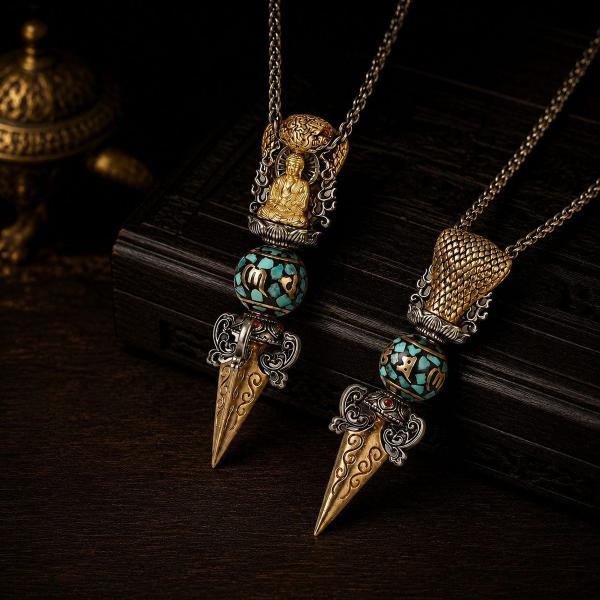
This piece puts a Buddha image and a vajra together. When a figure and an implement share one body the placing usually follows a rule: the Buddha central or above, the vajra as a border or as a counterpoint on the back, never taking the main seat. With a combined piece like this, look first at whether the face is properly formed, then at whether the prongs are symmetrical; only when both pass is it worth talking about fine work, because otherwise the densest line is wasted. The hand gesture matters too: the earth-touching and wish-granting mudras each have their shape, and a blurred lump has usually never been chased at all.
Shakyamuni images differ noticeably between China and Tibet. Chinese examples mostly have snail-shell curls, a robe over both shoulders and a seated cross-legged pose; Tibetan ones often carry a crown and necklaces, with richer ornament. This one takes the plainer line, so it does not shout in daily wear and holds its own with a shirt or a knit. As a gift for an older relative it will be accepted more readily than the fierce protector figures. Worn against the skin, white copper builds a thin dark film, and some people like that film, saying it makes the piece look old.