


Menu
By theme
By theme

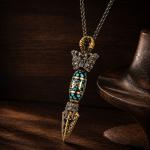
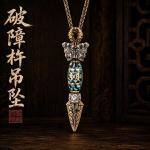


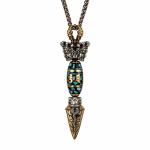
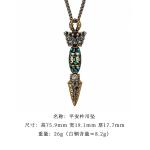
{{ variable.name }} : {{ variable.values[selectedVariantsIndex[variable_index]].name }}
Quantity:
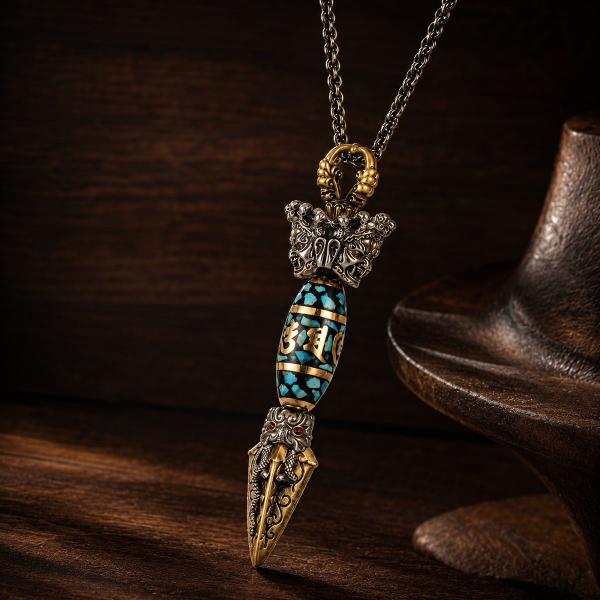
The demon-subduing vajra shares its origin with the vajra itself, though the weight of it falls on the blade. The kila, called phurba in Tibetan, has a three-edged blade, a handle, and a beast's head or a Buddha head at the top. In Tibetan ritual it is used to mark out a boundary and keep obstacles outside it, which gives it a harder character than an ordinary vajra. In older practice it came with a box of its own, one implement to a case, which shows the standing it had. The character originally meant a stake driven into the ground to mark a boundary, and only later came to mean a ritual implement.
The phurba has practices of its own in the Nyingma school, where the deity Vajrakilaya has three heads, six arms and wings at the back, and a ferocious appearance. Pendants usually take the implement rather than the deity, so the piece reads as an object and not as an image. That is easier for daily wear: fewer considerations, and no need to treat it by the rules for a shrine figure. The Kagyu and Sakya schools also carry phurba lineages, each with its own liturgy. Vajrakilaya with three heads and six arms and the kila as an object are two different things, and should not be run together.
The three edges of the blade catch three highlights in the light, and that is where you read the form. The ridges should be straight and the faces even; a slight twist and the whole piece goes slack. White copper has a pale ground, and the depth of the ridges shows more clearly in the metal than in a photograph, so when it arrives, turn it against the window light and the quality of the work is plain at once, with nobody needing to explain it. The joint between blade and handle is where trouble usually starts: look for an obvious seam, because a rough joint will work loose in time. The reflections across the faces should be even; one bright patch and one dull means the polishing never went flat. That cannot be faked.
With implements of this kind there is not much taboo about everyday wear. Taking it off before the bathroom or before bed is a habit many people keep, mainly from fear of knocks rather than anything else. White copper is a little harder than brass, and scratches show more against a pale ground, so keep it clear of hard objects — above all, do not wear it on the same wrist as a watch. With a cord, a thicker cotton or leather one works better; a fine chain makes an implement look flimsy.
Kept as a pair with a vajra bell it follows tantric usage. Buying one on its own makes no difference to wearing it, and there is no need to hunt down a bell just to make up a set. Patches of darkening on the copper are ordinary oxidation: wipe with a dry cloth and do not soak it, because water seeping back out of the crevices afterwards is hard to clear and the whole piece has to be wiped over again. The colour of white copper leans to a blue-grey rather than a bright white; if that matters to you, look closely before ordering.