


Menu
By theme
By theme



{{ variable.name }} : {{ variable.values[selectedVariantsIndex[variable_index]].name }}
Quantity:
The beast mask has its home on Shang and Zhou bronzes. That taotie and kui-dragon repertoire: large eyes, a broad nose bridge, spread symmetrically to either side, with almost no empty space left. Later generations moved the composition onto jade, roof tiles, door knockers and sword fittings, and the beast mask became a general name for a class of face rather than for a particular animal. The name need not be taken too literally; what matters is the armature of the face. On Shang and Zhou pieces the mask was usually cast on the belly of a ding, gui or zun, in a fixed position that was not moved about. The kui is a one-legged dragon and the taotie a gluttonous beast, and the old texts describe them differently.
The mask on old pieces is generally assembled: horns from an ox, eyes from a tiger, body from a dragon, pieced into a face that does not exist in the world, the better to press home a sense of authority. On Shang and Zhou vessels the mask sits at the centre of the belly with cloud-and-thunder scroll filling the ground to either side, so that from a distance it reads as one face and close up as countless fine lines. That way of looking — whole at a distance, line at close range — has not changed, and small pieces work by the same rule. The scroll is the ground and the mask the subject, one dense and one open, and only then does distance give depth.
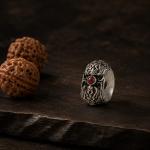
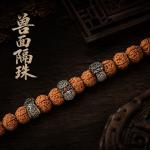
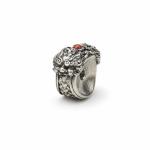
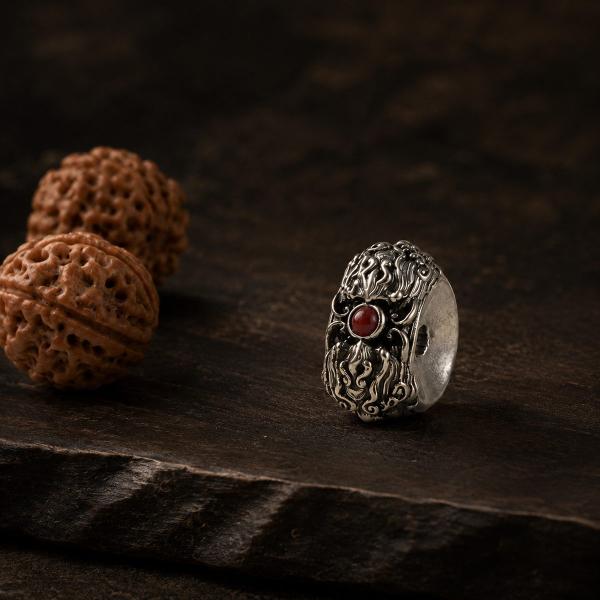
Made into a spacer, the mask is usually complete on the front only, with the back left flat or given over to the hole. Worn face outward and set between two main beads, it reads as a pause. On a string of plain beads one mask is enough; two crowd one another and eat the emphasis, which is worse than none at all. If the spacer is much smaller in diameter than the main beads it sinks between them and the face disappears.
Pairing it with patterned beads takes care. If the bracelet already carries carved pieces, adding a mask sets two things competing for the same attention. A white copper mask has strong light and shade, so wipe it along the lines of the pattern with a soft cloth in ordinary use, and lift dust out of the hollows with a soft brush. Do not reach for a needle: it scratches easily, and a scratch on this metal is a white line that will not hide. Casting pits, where they occur, mostly sit in the hollows, and turning the piece against the light will show them. Do not put it on straight after wiping; a layer of hand sweat actually makes it bloom.
Beast masks have their counterpart on Tibetan objects too, mostly on the handles of implements, on horse trappings and on door fittings, with a fuller composition than in the central plains and a more exaggerated treatment of teeth and mane. The two are not one system, so do not talk about them as though they were, and do not insist on who influenced whom. When putting a combination together, sorting by style is more practical than sorting by school. Tibetan masks usually sit with scrolling foliage and flame, Chinese ones with cloud-and-thunder scroll, and the lineage shows at a glance.