


Menu
By theme
By theme





{{ variable.name }} : {{ variable.values[selectedVariantsIndex[variable_index]].name }}
Quantity:
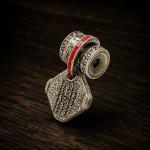
The Tibetan script was created in the seventh century by Thonmi Sambhota on the model of Sanskrit, with thirty consonants and four vowel signs, written from left to right. Scripture cut into a bead has to follow the order and the letterforms: no joining letters at will, and no stretching a stroke for the sake of appearance. This is where it differs from Chinese character work, which can run strokes together for momentum; Tibetan cannot. The stroke order is its own system too, beginning mostly at the upper left and pressing down at the end, and the engraver has to follow it. Thirty consonants with four vowels make a more complex spelling system than Chinese, and one wrong letter changes the whole sentence.
The text on spacers of this kind is usually a short mantra or the six-syllable mantra. Om mani padme hum is everywhere in Tibetan areas, cut on prayer wheels, mani piles and lintels, and the merit of reciting it is set out in several scriptures. Cut into a bead, it amounts to carrying a familiar line with you, to be said while walking or waiting for a bus. Translations of its literal sense differ; one common reading is 'the jewel in the lotus'. Beyond short mantras, some pieces carry a whole verse of scripture, with smaller lettering and a higher price.
Spacers are usually used in pairs, one to the left of the guru bead and one to the right, symmetrically placed. A single one also works, set between main beads as a division. The hole must be true; if it is off, the whole string pulls to one side, and however you adjust it after threading it feels wrong and has to come apart again. A pair should be close in size, since an obvious difference shows immediately once they are strung.
Once a copper piece is engraved, dust settles in the recesses and the lettering darkens, which is no bad thing — it makes the characters read more clearly. Clean with a dry soft brush, not under running water; water left in the cuts rusts, especially in the damp south, where a single plum-rain season makes the difference plain. If verdigris has already appeared in the lettering, wipe with a dry soft cloth rather than vinegar, which bites into copper. There is no hurrying it.
Tibetan letterforms divide into headed and headless, and beads usually use the headed form, with horizontal and vertical strokes and a head-line at the top of each letter. Looking at a piece in Tibetan script, check first whether that head-line is even: even means tidy, ragged means hurried. Spacing should be regular as well; lettering that runs wide and then narrow is usually rushed work, and two beads in a set that do not match were probably not from the same batch. On old pieces the edges of the cuts are rounded, on new ones sharp, and the hand knows as soon as it touches them.