


Menu
By theme
By theme


{{ variable.name }} : {{ variable.values[selectedVariantsIndex[variable_index]].name }}
Quantity:
The story of Zhong Kui took shape in the Tang. The tale goes that Emperor Xuanzong, laid up ill, dreamed of a great demon eating a small one; the demon called himself Zhong Kui, a candidate from Mount Zhongnan who had failed the examinations because of his ugly face, dashed his head against the palace steps and died, and swore after death to rid the world of every evil spirit. The emperor woke cured and ordered a portrait painted. Once legends of this kind enter painting, the figure becomes fixed: Wu Daozi painted him, later hands copied, and the look settled. Mount Zhongnan lies in Shaanxi and was a haunt of hermits in the old days, so giving Zhong Kui his native place there is a kind of arrangement.
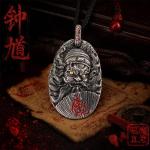
The image is fixed: leopard head, round eyes, an iron-dark face, a curly beard, a red robe, black boots, a sword or a folding fan in hand. Both civil and martial versions exist: the civil one holds a tablet of office, the martial one a sword. The red robe is the marker that identifies him at a glance; blue robes appear too, rarely, and mostly as the invention of a local painter. His sword is usually the seven-star sword, with the Big Dipper on the blade, which painters generally do not detail, only dotting in seven stars. A bat often appears in these paintings as a guide, on the pun fu lai, 'fortune comes', and it sits at the edge of the picture.
Popular custom hung Zhong Kui's portrait at the Dragon Boat Festival. The fifth month was held to be an evil month, and hanging his image or pasting up a Celestial Master's talisman were old ways of warding off pestilence. Later he was hung at the year's end as well, under the name 'Zhong Kui welcomes fortune', the function broadening from driving off evil to inviting good. That one picture serves both festivals shows how loose popular usage has always been. At the Dragon Boat Festival there is a rule to the hanging: the face turned towards the door, for blocking.
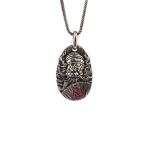
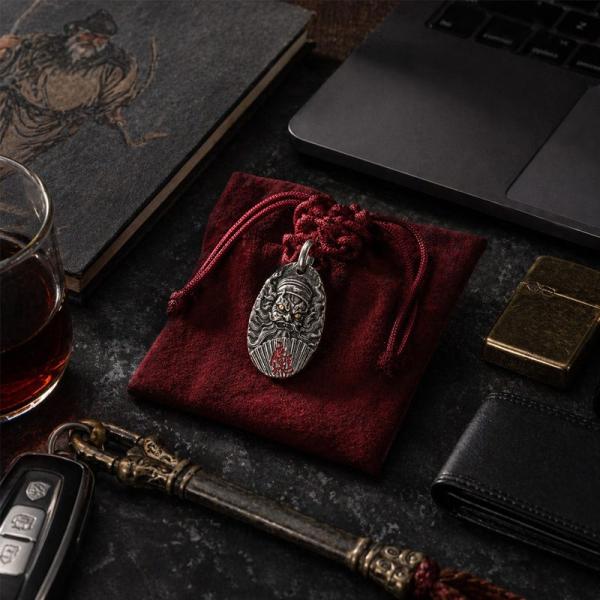
Made into a pendant, the red robe cannot hold its colour on copper, so the reading depends on the flow of the robe folds and the lines of beard and hair. Looking at a piece like this, see first whether the eyes have life, then whether the beard is grouped clearly; a blurred mass usually means the mould has been taken too many times. The eyes and brows carry the strength of the whole face, and if they are flat the piece goes dull. The robe folds are the main line, and the creases must run with the form; against it, and he looks as though a cloth has been thrown over him. The shape of the hat is drawn differently from place to place, stiff wings or soft, so it is no firm standard.
As something to wear it appeals mostly to men, on a dark cord or a leather one. Some hang it in the car; copper against glass rattles, so add a soft pad. Once the copper darkens, the black in the hollows sets off the beard and hair more clearly, and the longer it is worn the more it looks like a painting. That is the temper of copper and it cannot be hurried. As a gift for a friend in business it works better than a Guanyin figure, and the meaning is plainer.