


Menu
By theme
By theme

{{ variable.name }} : {{ variable.values[selectedVariantsIndex[variable_index]].name }}
Quantity:
Green Tara is the first of the twenty-one Taras. Green of body, standing for activity and rescue, one face and two arms, the right hand in the wish-granting gesture and the left holding an utpala flower whose stem runs up the arm and opens beside the ear. In Tibetan areas she is seen as an emanation of Avalokiteshvara's compassion, and calling her name in trouble is the core of her cult. Each of the twenty-one Taras has a name and a colour, and Green Tara stands first. She is usually shown with the right foot extended, ready to rise and help at any moment rather than sitting still. The syllable in her Chinese name means to ferry across, across and out of obstacles; literally there is nothing arcane about it.
The heart mantra is om tare tuttare ture soha. Seven syllables, chanted to long and short tunes in Tibetan areas; the literal sense is 'Tara, Tara, carry me across', plain and direct, which is why it has travelled so widely. Monasteries in China proper recite it too, with slightly different characters in transliteration and little difference in sound. In tradition each syllable answers to a colour and a direction, and the visualisation differs with the recitation; that is beyond the scope here.
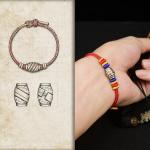
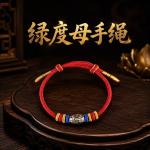
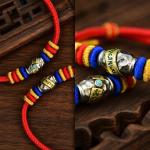
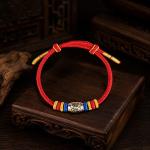
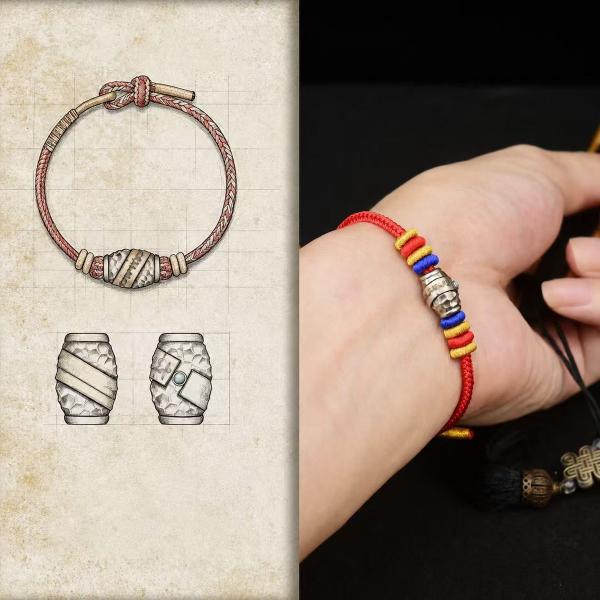
The materials here are mixed: a red cord as the base, with metal and beads in the middle, the exact arrangement as supplied. Mixed materials give variation in weight rather than the single lump of an all-metal piece; the drawback is two kinds of care to think about, since cord fears water and metal fears sweat, and each has to give way to the other. The junction between metal and cord is the first place to fail, so give it a gentle pull when it arrives and see how firm it is. If cord and metal differ too much in weight, the piece keeps rotating and the charm works its way round to the inside of the wrist. This is often overlooked.
The red cord has a protective use in both Chinese and Tibetan practice. Tying a red cord in your zodiac year is a Chinese custom; in Tibetan areas red cord usually appears together with a vajra knot. The two have different origins, and wearing them together does no harm — each says its own thing. Some people change the cord at the new year and burn the old one at the year's end, others wear the same one for years; either is fine. The red sheds colour onto pale cuffs, so avoid a white shirt for the first week.
Fit matters more than style in a wrist piece. Too tight and it pinches, too loose and it slides down over the hand, easy to lose when washing. An adjustable knot needs a little slack left in it; trim the cord ends short and singe them lightly with a lighter, and do not leave long tails, which fray as soon as they are wet. Left or right wrist is a matter of which hand you use, and whether it gets in the way of writing. On a slim wrist, draw the knot right in and tuck the surplus ends into the knot rather than leaving them sticking up.