


Menu
By theme
By theme




{{ variable.name }} : {{ variable.values[selectedVariantsIndex[variable_index]].name }}
Quantity:
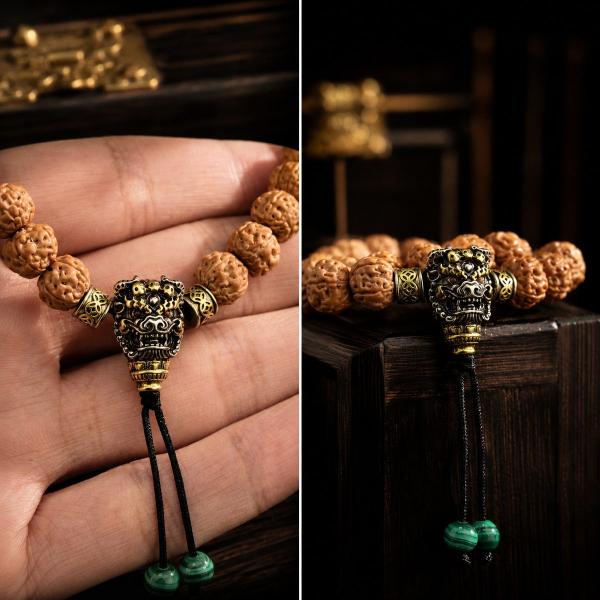
The three-hole bead is the guru bead position on a string. It has three holes: the main one runs straight through, the side one lets the cord out, and between them they gather the whole string and lead it on down to the guru tower, the back cloud and the drop. Whether a string hangs true is half down to this bead. Drill it crooked and no bead further on will rescue it. The tower sits below the three-hole bead, the back cloud below that, narrowing layer by layer, and only a clean finish makes the whole string tidy. Three-hole beads come as single-headed and double-headed; the single saves material, the double is steadier.
Yamantaka is the wrathful emanation of Manjushri, called Yamantaka in Tibetan, meaning conqueror of Yama. His iconography is nine faces, thirty-four arms and sixteen legs, treading on a buffalo and on various beings, and the presence is enormous. This is one of the most complex figures in the Tibetan system, with practices in both the Gelug and Nyingma schools and details that differ between them. The nine faces are arranged with the main face in the centre, three to each side and one on top, nine in all; the thirty-four arms are seventeen to each side. The sixteen legs tread on a buffalo, birds and beasts, standing for the pressing down of delusion and distraction, as the iconography sets out clearly.
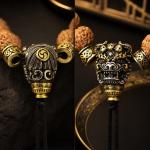
Shrunk to the scale of a three-hole bead, nine faces and thirty-four arms cannot all be made, so most pieces use the buffalo head and the Manjushri face above it as the identifying points. Looking at one of these, count the heads first, then see whether the Manjushri face is there; if both check out, you are close. If even the horns are omitted, the piece is only borrowing the name. The horns on the buffalo head should curve with force, thick at the root and tapering to the tip, narrowing all the way up so that they do not look dead. Where only one face is worked, the other side is usually left plain, and turned over it is a clean piece of copper.
The holes decide whether the bead is usable. They must be true; off by a little and the whole string sits crooked, and no amount of restringing straightens it. It suits dark wooden beads and bodhi seed alike; white copper's cool tone against a dark ground makes the guru position stand out and gives the string its centre of gravity. If there is a burr at the mouth of a hole, run a fine file lightly over it rather than forcing the cord through, which will cut it. The side hole should line up with the centre line of the main hole; off a little and the cord runs at an angle.
Between a copper three-hole bead and the other beads it is best to add a washer or a spacer, to reduce wear at the hole. Handled over years the copper darkens, and the wrathful face in the recesses grows more three-dimensional, which is the advantage of white copper for wrathful subjects. If a piece grows brighter with handling it is probably plated; white copper does not do that. White copper goes best with rosewood and bodhi seed, while against South Red the red and the white fight one another — a matter of taste.