


Menu
By theme
By theme



{{ variable.name }} : {{ variable.values[selectedVariantsIndex[variable_index]].name }}
Quantity:
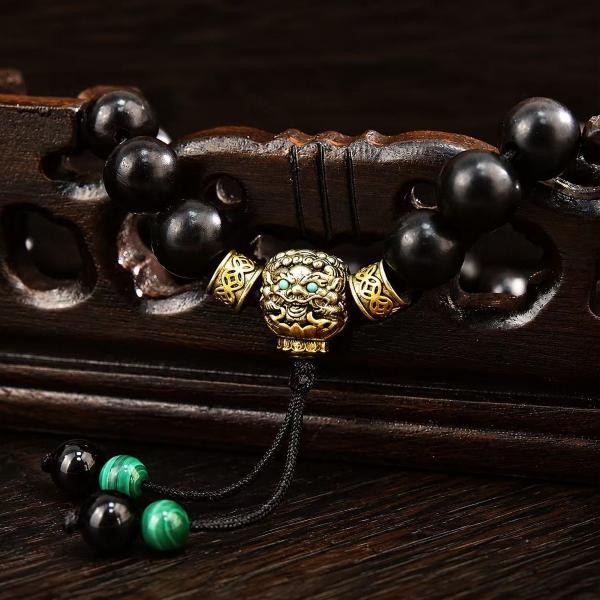
The citipati is a class of auspicious beast on Tibetan objects, with no exact equivalent in Chinese usage. Its place is something like that of the Chinese beast mask: mostly on the handles of implements, on three-hole beads and on the face of a back cloud, with a great open mouth and mane and scrolling foliage spread to either side. Anyone used to Chinese masks finds it wilder at first sight. The mouths on these are usually wide open, teeth showing, tongue curled, a combination rare in Chinese masks. The eye corners tend to tilt upward, which is the easiest place to tell the two apart.
A beast of this kind belongs to no particular deity; its job is to hold things steady. Tibetan objects like a beast face at a turn or a joint, as though adding a lock to the structure, and visually as a full stop. Woodwork, copperwork and leather all do it, high and low alike, as a shared habit of craftsmen. On copper the mask is usually cast at a point that carries load, on wood carved near a tenon, for the same reason. The face is not something to be enshrined; it is a component of the object, and position matters more than identity.
On a three-hole bead the beast's mouth usually faces down, towards the body of the string, for the sense of swallowing it. Whether the mouth is openwork or solid varies from maker to maker: openwork reads light, solid reads weighty, and the beads decide. Light wooden beads need solid to hold them down; heavy stone beads with solid as well become a dead weight on the wrist. If the mouth is hollow, the cord passes through it in threading and looks as though it is being held there. Once the direction of the mouth is settled, the front and back of the whole string are settled too.
A white copper mask works by difference in height: raised areas bright, hollows dark, and a turn of the light brings it alive. If the whole piece is worked flat the face blurs, which is what to avoid when choosing one of these. Flatness that shows in a photograph is flatter still in the metal. Darkness in the hollows is not dirt, and you should not pick at it with a needle, because what comes up underneath is bare colour and the result is uneven. Side light shows the layers of the face most clearly.
It sits most safely with plain beads. Beads that are themselves busy plus a mask quickly turn messy. When wiping, follow the direction of the mane rather than rubbing across it, since cross-rubbing flattens the highlights and the face loses its spirit. Dust in the crevices comes out with a soft brush rather than under water; left undried, water leaves white patches. Do not string white copper and pure copper together — they oxidise at different rates and part company in colour within six months. With new bodhi seed, which is pale, white copper cannot hold its own, so break it in with older beads first.