


Menu
By theme
By theme

{{ variable.name }} : {{ variable.values[selectedVariantsIndex[variable_index]].name }}
Quantity:
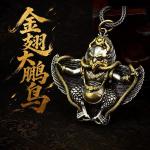
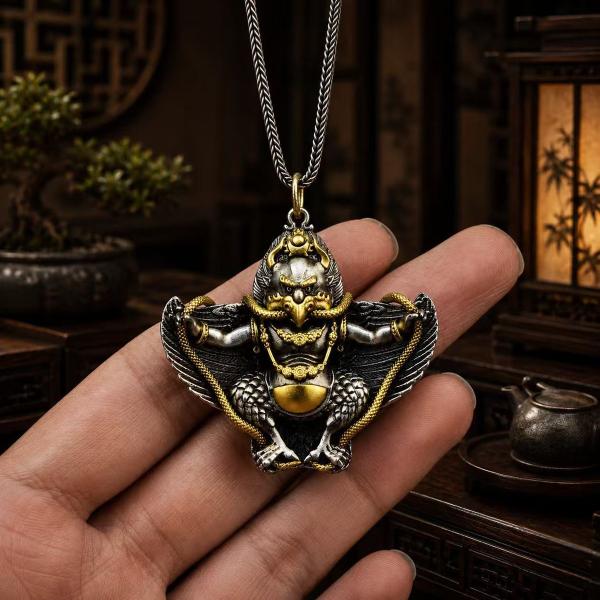
The garuda is one of the eight classes of heavenly beings and dragons in Buddhist cosmology. In legend it feeds on nagas, with a wingspan that can blot out sun and moon, and golden feathers as its mark. After Buddhism arrived it changed from an Indian divine bird into a protector, and in Chinese temples it appears on coffered ceilings and stone pillars. In Chinese painting it is usually golden-bodied with a bird's head and spread wings, a pair of nagas beneath its feet, in a fixed composition. Garuda is a transliteration; the translated name means golden-winged, and the two names refer to the same being.
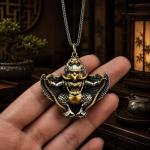
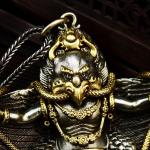
In Tibetan iconography the garuda is usually human-faced with a bird's body: horns on the head, a beak like a hawk's, the arms spread as wings, a snake gripped in the hands. The snake stands for affliction and for the naga race, and holding it means subduing them. The combination appears in the corners of thangkas and at the tops of implements, usually at the highest point, for the sense of soaring. Between the horns and the beak are the eyes, usually glaring, almond-shaped with a black centre. The snake it grips is sometimes drawn as one and sometimes as two, coiled in the hand or bitten in the beak.
Some garudas are made purely as birds, without a human face, keeping only the outline of spread wings. Each has its own flavour: the human-faced version stays closer to the liturgy, while the bird form suits everyday wear and looks less like a ritual object. Which to choose depends on what you usually wear. Pure bird forms often leave out the hands, with the wings running straight to the shoulders and a cleaner line. Women tend to buy the bird form; the human-faced one is more often bought as a gift for an elder.
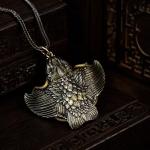
This one is white copper, and the spread wings read horizontally across the chest, so a short chain looks better than a long one, which would let the pendant hang too low. With a collared shirt the wing tips catch in the fabric, so watch for that. Knitwear is the worst for snagging; check before you go out. The feathers are layered one over another, the outermost longest, and the tips should be even. A thick chain hides the root of the wings; a fine one suits it better. Do not overdo the thickness.
The beak and the wing tips are the two weak points, so do not press on them when putting the piece away. Wipe dull copper with a dry cloth and the crevices with a soft brush. If it is stored for a long time, pad the bag with a layer of soft paper so that the wings are not pressed against a corner. If a wing is already bent, do not force it back yourself: white copper springs, and bent too far it snaps. As a car charm, tie the cord to the loop on the bird's back rather than to a wing tip, which cannot take the strain. Fingerprints on the copper press out with a dry cloth, not a wet wipe.